
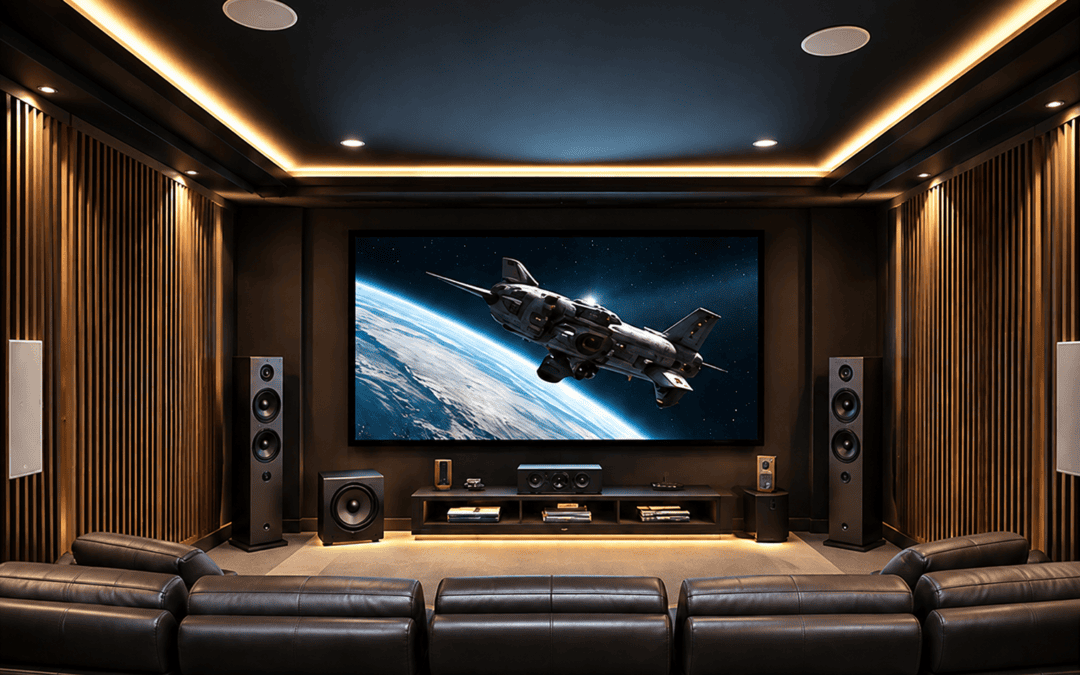
Building a home theater is about much more than buying a large television, projector and powerful speakers. Instead, creating an immersive cinema experience requires the right combination of speakers, placement, room acoustics and calibration.
So, how many speakers do you really need for a Dolby Atmos home theater?
The answer depends on several factors. For example, room size, seating arrangement, ceiling height and listening position all influence the ideal configuration. Furthermore, your choice should reflect whether you want a simple surround system, a dedicated cinema or a high-end immersive audio environment.
You may have already seen terms such as 5.1.2, 5.1.4 and 7.1.4. Although these numbers may look complicated initially, they actually provide a simple way to describe a home theater speaker layout.
Most importantly, adding more speakers does not automatically create better sound. A carefully designed 5.1.4 system can be more convincing than a poorly positioned 7.1.4 system.
Therefore, before purchasing additional speakers, it is worth understanding what each configuration means and how it should work within your room.
What Is a Dolby Atmos Home Theater?
Dolby Atmos is an immersive audio format designed to create a three-dimensional sound experience.
Traditional stereo places sound between the left and right speakers. Meanwhile, a conventional 5.1 surround system adds a center channel, two surround channels and a subwoofer.
Dolby Atmos introduces another dimension by adding height information. As a result, compatible sound can appear to come from above as well as around the listener.
Imagine watching a movie in which an aircraft travels overhead. With a properly configured Atmos system, the sound can move through the height layer instead of remaining restricted to the horizontal speaker plane.
The same principle applies to rain, thunder, helicopters, flying objects and atmospheric effects. Consequently, the listener can experience a much stronger sense of three-dimensional movement.
Dolby describes the intended experience as an immersive "dome of sound" around the listener. Proper speaker placement therefore plays an important role in achieving that effect.
For a dedicated home theater, this additional dimension can make movies, games and compatible music considerably more engaging.
What Do 5.1.2, 5.1.4 and 7.1.4 Mean?
At first, Dolby Atmos numbers can seem confusing. Fortunately, the system is straightforward once you understand what each number represents.
The first number identifies the ear-level speaker channels.
The second number identifies the LFE channel.
Finally, the third number identifies the height or overhead speaker channels.
For example, Dolby describes a 5.1.4 system as five ear-level speakers, one LFE channel and four overhead speakers.
5.1.2
A typical 5.1.2 home theater includes:
- Left front speaker
- Center speaker
- Right front speaker
- Left surround speaker
- Right surround speaker
- One LFE channel
- Two height speakers
5.1.4
A 5.1.4 configuration keeps the same five ear-level channels but adds two more height channels.
The result is:
- Five ear-level speakers
- One LFE channel
- Four height speakers
7.1.4
A 7.1.4 system adds two rear surround channels to the five ear-level channels.
Therefore, it includes:
- Seven ear-level speakers
- One LFE channel
- Four height speakers
Quick comparison
| Configuration | Ear-Level Channels | LFE Channel | Height Channels | Typical Application |
|---|---|---|---|---|
| 5.1.2 | 5 | 1 | 2 | Smaller rooms |
| 5.1.4 | 5 | 1 | 4 | Dedicated home theaters |
| 7.1.2 | 7 | 1 | 2 | Larger surround systems |
| 7.1.4 | 7 | 1 | 4 | Larger dedicated theaters |
| 7.2.4 | 7 | 2* | 4 | Large rooms and advanced systems |
*The conventional notation can be interpreted differently depending on the equipment and documentation. Dolby's professional guidance clarifies that the LFE channel can have one or more associated subwoofers, while additional bass-management subwoofers are not necessarily represented by the x.y.z notation.
How Many Speakers Does a Home Theater Actually Need?
There is no universal speaker count that works perfectly for every room.
Instead, the ideal number depends on how large the room is, how many people will use it and how immersive you want the experience to be.
For many homeowners, the main decision comes down to three configurations:
5.1.2, 5.1.4 or 7.1.4.
Each layout provides a different balance between installation complexity, room requirements and immersive performance.
Therefore, choosing the right system starts with the room rather than the equipment list.
5.1.2 Home Theater: A Strong Starting Point
A 5.1.2 home theater is often the simplest way to introduce Dolby Atmos into a dedicated or multipurpose room.
This configuration combines five ear-level channels with two height channels and an LFE channel.
The front stage consists of:
- Left
- Center
- Right
The surround layer adds:
- Left surround
- Right surround
Finally, two height speakers create the overhead layer.
Dolby states that 5.1.2 can work well in almost any space.
When does 5.1.2 make sense?
This setup can be a good choice when:
- Your room is compact.
- You have one primary seating row.
- Ceiling installation is limited.
- You are upgrading from 5.1.
- You want to control installation costs.
- You still want an immersive height layer.
However, two height channels provide less overhead coverage than four.
For that reason, homeowners designing a dedicated cinema from scratch may want to consider 5.1.4 instead.
5.1.4 Home Theater: The Sweet Spot for Many Dedicated Rooms
For many serious home theater installations, 5.1.4 offers an excellent balance.
The configuration retains five ear-level channels while increasing the height layer to four speakers.
A typical layout includes:
- Left front
- Center
- Right front
- Left surround
- Right surround
- One LFE channel
- Top-front left
- Top-front right
- Top-rear left
- Top-rear right
Dolby's consumer guidance recommends a 5.1.4 layout for enjoying Dolby Atmos and describes the four height speakers as helping create a fully immersive dome of sound.
Why is 5.1.4 so effective?
Consider a helicopter moving from the front of the room toward the rear.
With only two height speakers, the overhead layer has fewer physical positions available.
By comparison, four height speakers establish both front and rear overhead positions.
As a result, sound movement through the height field can become more convincing.
For many dedicated rooms, that combination provides an excellent balance between immersion and installation complexity.
7.1.4 Home Theater: Designed for Larger Rooms
Larger rooms can benefit from additional rear surround channels.
A typical 7.1.4 home theater includes:
- Left front
- Center
- Right front
- Left side surround
- Right side surround
- Left rear surround
- Right rear surround
- One LFE channel
- Four height channels
The main difference from 5.1.4 is the addition of dedicated rear surrounds.
Consequently, the listener can experience more complete front-to-back surround coverage when the room provides enough space for proper separation.
Dolby's current 7.1.4 overhead setup identifies left and right front speakers, center, side surrounds, rear surrounds and four overhead positions.
When should you consider 7.1.4?
A 7.1.4 system becomes particularly attractive when:
- The room is large.
- You have a dedicated cinema.
- There is sufficient space behind the main seating.
- You have multiple seating rows.
- You want stronger rear surround coverage.
- You want a more advanced long-term system.
Nevertheless, installing seven ear-level channels in a small room can add complexity without providing a proportional improvement.
In such cases, a carefully designed 5.1.4 setup may be the better solution.
What About 7.2.4?
A 7.2.4 system takes the 7.1.4 concept further by using additional subwoofer capability.
The goal is not simply to make bass louder.
Instead, multiple subwoofers can help distribute low-frequency energy more evenly throughout a large room.
This can become particularly useful when your home theater contains:
- Two seating rows
- A wide listening area
- Large room dimensions
- Several listening positions
- Challenging bass behavior
Dolby notes that most setups use one subwoofer, although larger spaces may benefit from two.
5.1.2 vs 5.1.4 vs 7.1.4: Which Home Theater Setup Is Best?
Choosing between these configurations becomes easier when you consider the room first.
Choose 5.1.2 if:
You have a smaller room and want an affordable introduction to immersive audio.
Choose 5.1.4 if:
You are building a dedicated theater and want four height channels without adding rear surround speakers.
Choose 7.1.4 if:
You have enough room for separate side and rear surround positions.
Consider 7.2.4 if:
Your theater is large and multiple seating positions make more consistent bass particularly important.
Ultimately, the best configuration is the one that works with the room rather than against it.
Understanding the Role of Each Home Theater Speaker
Speaker count is only one part of the equation.
Equally important, every speaker should have a clear purpose.
Left and Right Front Speakers
The left and right speakers establish the main front soundstage.
They reproduce music, sound effects and much of the cinematic information.
For a premium system that will also be used for music listening, these channels deserve particular attention.
For example, high-quality floorstanding speakers can provide a broad soundstage, strong dynamics and powerful full-range reproduction.
That makes tower speakers particularly attractive for homeowners who want their home theater to double as a serious Hi-Fi music system.
Center Channel Speaker
The center channel plays a critical role in movie dialogue.
It anchors voices to the screen while also handling important center-stage effects.
Ideally, the speaker should be positioned as close to the display as practical.
Dolby recommends placing the center speaker just above or below the display so that dialogue appears to originate from the screen.
This becomes especially important in a large projection theater.
After all, nobody wants dialogue to appear as though it is coming from somewhere below the screen.
Surround Speakers
Surround speakers create the sound field around the listener.
They can reproduce:
- Environmental effects
- Crowd noise
- Movement
- Rear effects
- Atmospheric information
- Directional transitions
A 5.1 setup uses two surround channels.
Meanwhile, 7.1 adds two rear surround channels.
As a result, larger rooms can benefit from more complete front-to-back sound movement.
Height Speakers: The Key to Dolby Atmos
Height speakers are what add the vertical dimension to a Dolby Atmos system.
They can be installed directly in the ceiling or implemented using compatible upward-firing Dolby Atmos-enabled speakers.
The purpose is to reproduce overhead information.
For example, a movie may place:
- Rain above the listener
- A helicopter overhead
- Thunder across the ceiling
- Aircraft moving through the room
- Atmospheric effects above the seating
Dolby explains that height speakers allow sound to be positioned and moved within the three-dimensional sound field.
Therefore, their placement deserves as much attention as the front and surround channels.
In-Ceiling vs Up-Firing Atmos Speakers
There are two common approaches to reproducing the height layer.
In-Ceiling Speakers
These speakers are installed directly in the ceiling and aim toward the listening area.
Their advantages include:
- Direct overhead sound
- Clean architectural integration
- Minimal floor clutter
- Dedicated height positioning
- A discreet visual appearance
For this reason, in-ceiling speakers are particularly attractive for luxury home theaters where the audio system needs to integrate with the interior.
Up-Firing Speakers
Up-firing speakers sit at ear level and direct sound toward the ceiling.
The ceiling then reflects the sound back toward the listener.
This approach can be useful when installing speakers directly overhead is impractical.
However, ceiling height, shape and surface characteristics can influence reflected sound.
Consequently, the room should be considered before deciding between the two approaches.
Dolby's current setup guides support both overhead speakers and Dolby Atmos-enabled/up-firing approaches.
Can In-Wall Speakers Be Used in a Home Theater?
Yes.
In-wall speakers can be an excellent solution for surround channels, particularly when you want a clean architectural appearance.
Instead of placing speaker cabinets on stands or furniture, the speakers can become part of the wall.
As a result, the room can maintain a more minimalist appearance without sacrificing dedicated surround channels.
A premium LiYA configuration could combine:
Floorstanding speakers at the front
with
in-wall surround speakers
and
in-ceiling Atmos speakers
plus
a dedicated subwoofer.
This hybrid approach can provide both high-fidelity music reproduction and immersive movie playback.
How Room Size Changes Your Home Theater Speaker Count
Room dimensions should influence the configuration you choose.
Small Home Theater
For a compact room, 5.1.2 can be a practical starting point.
It provides a front soundstage, surround channels and a basic overhead layer without requiring extensive installation.
If the ceiling allows it, moving to 5.1.4 can provide a stronger overhead experience.
Medium Home Theater
A medium-sized room is often well suited to 5.1.4.
Four height channels provide a more complete overhead layer while the five ear-level channels keep the system relatively straightforward.
Therefore, this configuration offers a useful balance for many dedicated theaters.
Large Home Theater
Larger rooms can accommodate more channels.
In particular, 7.1.4 can make sense when there is enough space to position side and rear surrounds separately.
Furthermore, a larger room may benefit from multiple subwoofers if bass consistency becomes difficult to achieve.
What If Your Home Theater Has Two Rows of Seating?
Multiple seating rows require more careful planning.
The main listening area should be positioned so that the sound field remains balanced across the seats.
At the same time, overhead speakers need to be positioned according to the listening area rather than simply being spread evenly across the ceiling.
Dolby's setup guidance recommends establishing a central seating/listening position and using the speaker-positioning guides to determine placement.
For that reason, professional installation can be particularly valuable in a multi-row theater.
A well-planned installation considers:
- Screen position
- Seating distance
- Seating width
- Ceiling height
- Speaker angles
- Speaker dispersion
- Acoustic treatment
- Subwoofer placement
- Calibration
Why Home Theater Speaker Placement Matters So Much
Buying additional speakers does not automatically improve a system.
Instead, placement determines whether those speakers work together as intended.
Dolby emphasizes the importance of speaker height, placement, reflections and the listening sweet spot when setting up an Atmos system.
Imagine having twelve excellent speakers positioned randomly throughout a room.
The result could be less convincing than a carefully installed eight-speaker system.
Therefore, the installation plan should come before the equipment shopping list.
A Simple Way to Think About Home Theater Speaker Placement
Think of your room as three sound layers.
Layer 1: Front Soundstage
The front stage contains:
Left + Center + Right
These speakers establish the main cinematic image.
Meanwhile, the center channel keeps dialogue anchored to the screen.
Layer 2: Surround Sound
Surround speakers create the sound field around the listener.
In a 5.1 system, this means two surround channels.
With 7.1, two additional rear surround channels extend the sound field behind the listener.
Layer 3: Height Sound
The height layer adds the vertical dimension.
A 5.1.4 or 7.1.4 system typically uses four overhead positions.
Consequently, the listener experiences sound not only in front and behind, but also above.
Don't Forget Room Acoustics
Even excellent speakers can sound disappointing in a poorly controlled room.
Hard floors, bare walls and large reflective surfaces can create unwanted reflections.
As a result, the sound may become:
- Harsh
- Echoey
- Boomy
- Unclear
- Less precise
Acoustic treatment can help control these reflections.
Depending on the room, treatment might include:
- Acoustic panels
- Rugs
- Curtains
- Absorption
- Diffusion
- Purpose-built acoustic products
- Carefully selected furniture
However, the objective is not to make the room completely dead.
Instead, a well-designed space should provide controlled acoustics while retaining a natural sense of openness.
Why Calibration Matters in a Home Theater
Once the speakers are installed, calibration becomes the next important step.
Every room behaves differently.
Furniture, walls, ceiling height and speaker positions can all affect the sound reaching the listener.
Consequently, room correction and calibration can help the system achieve a more balanced result.
Dolby notes that calibration can help optimize an Atmos system and that many AV receivers include built-in calibration tools.
For a premium home theater, professional calibration can be especially useful.
A properly calibrated system can improve:
- Tonal balance
- Dialogue clarity
- Speaker integration
- Surround transitions
- Bass consistency
- Overall immersion
Does More Speakers Always Mean Better Sound?
No.
This is one of the most important points to understand before designing a home theater.
A 7.1.4 system has more channels than a 5.1.4 system. However, that does not mean it will automatically sound better in every room.
If the room cannot provide proper separation between side and rear surrounds, the additional channels may offer limited benefit.
Similarly, four ceiling speakers will not perform optimally if they are positioned without considering the seating area.
Therefore, speaker quality, placement, acoustics and calibration should be considered alongside channel count.
Can a Home Theater Also Be a Hi-Fi Music System?
Absolutely.
A well-designed home theater does not have to be used exclusively for movies.
In fact, homeowners who enjoy both music and cinema can build a system that performs exceptionally well in both areas.
A premium hybrid configuration might include:
Floorstanding Speakers
These can provide the main front soundstage while also delivering high-quality stereo reproduction for music.
Center Speaker
This channel handles dialogue and important center-stage information.
In-Wall Speakers
These can provide discreet surround channels without placing large cabinets throughout the room.
In-Ceiling Speakers
These add dedicated height channels for Dolby Atmos.
Subwoofer
Low-frequency effects gain greater impact while music can benefit from deeper bass extension.
Together, these components can create a versatile system for both critical listening and cinematic entertainment.
Should You Build Your Home Theater All at Once?
Not necessarily.
A staged upgrade can be a sensible way to build a high-quality system without compromising the initial investment.
Stage 1: Start With Stereo
Begin with:
2.0 or 2.1
This creates a strong foundation for music.
Stage 2: Add a Center and Surrounds
Move to:
5.1
Now you have a conventional surround system.
Stage 3: Add Two Height Channels
Upgrade to:
5.1.2
The system now gains an immersive overhead layer.
Stage 4: Add Two More Height Channels
Move to:
5.1.4
This creates a more complete overhead sound field.
Stage 5: Add Rear Surrounds
For a larger room, consider:
7.1.4
Stage 6: Consider Additional Subwoofer Capacity
If your room is large or contains multiple seating positions, consider adding another subwoofer where appropriate.
In this way, you can build toward a high-performance system without replacing your entire setup at every stage.
What Is the Best Dolby Atmos Setup for a Home Theater?
There is no universal winner.
Instead, match the configuration to your room.
Best for a Smaller Room: 5.1.2
This setup provides a relatively simple entry into immersive audio.
Best Balance for Many Dedicated Rooms: 5.1.4
Four height channels provide a more complete overhead layer without requiring rear surrounds.
Best for Larger Dedicated Theaters: 7.1.4
Additional rear surround channels can improve the surround field when the room has enough space.
Best for Large, Complex Rooms: 7.2.4
Multiple subwoofers can be useful when the listening area is large and bass consistency becomes a challenge.
Ultimately, the best home theater is the one that uses the room effectively.
A Note About Dolby Atmos Requirements
There is an important distinction between consumer playback and professional mixing environments.
For home entertainment playback, Dolby's consumer guide lists several configurations, including 5.1.2 and 5.1.4. Dolby specifically recommends 5.1.4 for enjoying Dolby Atmos and says 5.1.2 can work well in almost any space.
By contrast, Dolby's professional guidance recommends a minimum 5.1.4 layout for mixing Dolby Atmos home-entertainment content, with 7.1.4 identified as the preferred minimum setup for a mix room.
Therefore, a homeowner should not interpret the professional mixing-room recommendation as a requirement to install 7.1.4 at home.
The correct choice still depends on the room and intended experience.
How LiYA HiFi Can Build a Complete Home Theater
A premium home theater should not feel like a collection of unrelated products.
Instead, every component should work as part of a carefully designed audio environment.
A LiYA HiFi system can combine:
Floorstanding Speakers
Positioned at the front, tower speakers can deliver a powerful cinematic soundstage while also supporting serious stereo music listening.
Center Channel
A dedicated center speaker can keep dialogue focused and properly aligned with the screen.
In-Wall Speakers
These can provide discreet surround channels while preserving the interior design.
In-Ceiling Speakers
Dedicated ceiling speakers can create the overhead layer required for an immersive Dolby Atmos installation.
Subwoofer
A dedicated subwoofer adds deep low-frequency energy to movie effects and music.
Amplification
Appropriate amplification provides the power and control required to drive the complete system.
As a result, the final theater can combine high-performance audio with a clean, premium interior.
The Biggest Home Theater Mistake: Buying Speakers Before Planning the Room
It is tempting to start with a shopping list.
Perhaps you decide that you want seven speakers, four ceiling speakers and two subwoofers.
However, the better approach is to begin with the room.
First, determine the seating position.
Next, establish the screen location.
Then, plan the front soundstage.
Afterward, position the surround and height channels.
Finally, choose speakers that fit the planned positions and performance requirements.
This approach helps prevent expensive installation mistakes.
So, How Many Speakers Do You Really Need?
The answer depends on your room.
A smaller home theater can work very well with 5.1.2.
For many dedicated rooms, 5.1.4 offers an excellent balance between immersion and installation complexity.
Meanwhile, larger theaters can take advantage of 7.1.4 when there is sufficient space for separate side and rear surround channels.
Large rooms with multiple seating positions may also benefit from additional subwoofer capacity.
Nevertheless, speaker quantity should never be the only goal.
The Right Speakers in the Right Places Matter More Than Simply Having More Speakers.
Proper placement creates the foundation.
Good acoustics allow the system to perform naturally.
Quality speakers reproduce the soundtrack accurately.
Appropriate amplification provides the required control.
Finally, calibration brings the entire system together.
Therefore, before adding another speaker, look at the room first.
Measure the space.
Plan the seating.
Determine the listening position.
Choose the appropriate Dolby Atmos configuration.
Then select speakers that complement one another.
That is how you turn a collection of equipment into a genuine home theater experience.
Frequently Asked Questions About Home Theater Speaker Setup
How many speakers do you need for Dolby Atmos?
Dolby Atmos can be enjoyed using several configurations. Common options include 5.1.2, 5.1.4 and 7.1.4. Dolby's consumer guidance recommends 5.1.4 for a strong immersive experience, while 5.1.2 can work well in many spaces.
Is 5.1.2 enough for a home theater?
Yes. A 5.1.2 setup can provide a convincing Dolby Atmos experience, particularly in smaller rooms. However, four height channels can create a more complete overhead sound field.
Is 5.1.4 better than 5.1.2?
For many dedicated theaters, 5.1.4 provides a stronger overhead experience because it uses four height channels instead of two.
Is 7.1.4 better than 5.1.4?
Not automatically. A 7.1.4 system adds rear surround channels, so it can be advantageous in larger rooms. Nevertheless, placement and calibration remain critical.
Do Dolby Atmos speakers have to be in the ceiling?
No. Dolby supports overhead speakers as well as compatible Dolby Atmos-enabled/up-firing approaches.
Do I need four ceiling speakers for Dolby Atmos?
No. Two height speakers can be used in a 5.1.2 system. For a more immersive dedicated theater, four height speakers can provide a more complete overhead layer.
Can I use floorstanding speakers in a Dolby Atmos home theater?
Yes. Floorstanding speakers can serve as the front left and right channels. Furthermore, they are particularly useful when the system will also be used for high-quality music listening.
Can I use in-wall speakers for surround sound?
Yes. In-wall speakers can be used for surround channels when they are correctly positioned and matched with the rest of the system.
Do I need two subwoofers?
Not always. One subwoofer can work very well in many rooms. However, larger rooms and multiple seating areas may benefit from additional subwoofer capacity.
What is the best home theater speaker configuration?
For many dedicated rooms, 5.1.4 provides an excellent balance. Meanwhile, larger rooms may benefit from 7.1.4, while compact rooms can work well with 5.1.2.
Does a more expensive home theater always sound better?
No. Speaker quality matters, but placement, room acoustics, system matching and calibration can have a major influence on the final result.
Build Your Home Theater Around the Room
The best home theater starts with a plan rather than a speaker count.
Instead of asking how many speakers you can fit into the room, ask how many speakers the room actually needs.
A carefully designed Dolby Atmos system can transform movies, games and compatible music into an immersive experience. Whether you choose 5.1.2, 5.1.4 or 7.1.4, the objective remains the same: create a balanced sound field that places the listener at the center.
With the right combination of floorstanding, center, in-wall, in-ceiling and subwoofer solutions, your home can become more than a place to watch movies.
It can become your own private cinema.
LiYA HiFi — Live Your Audio.