
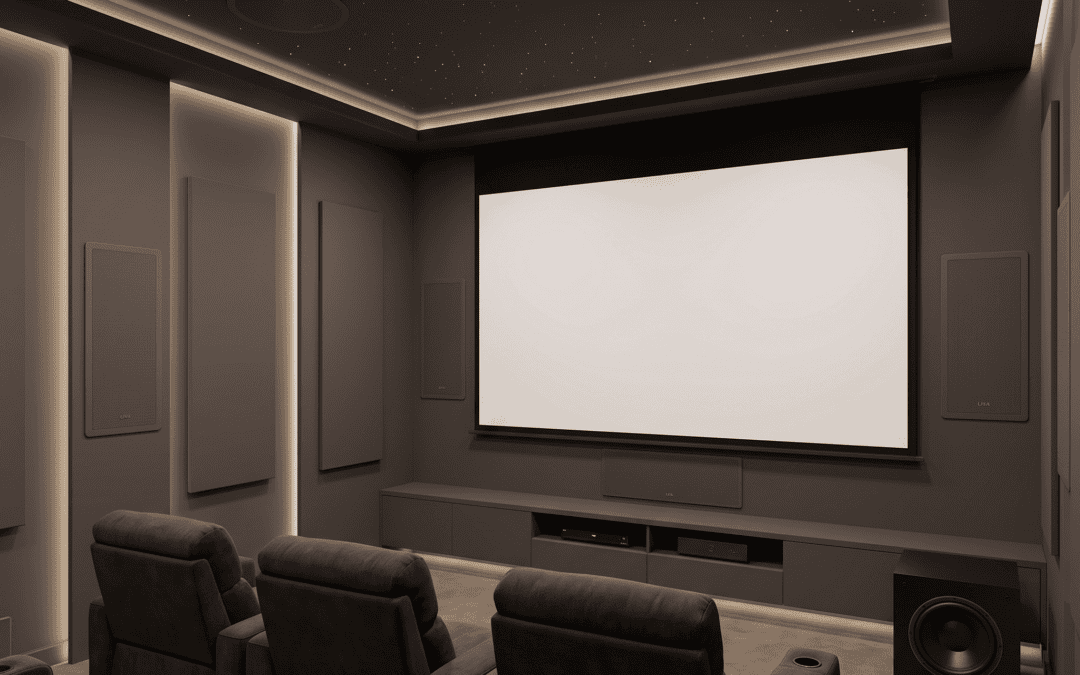
Learning how to build a home audio system starts with understanding your room, listening habits, speakers, amplifier, subwoofer, and placement. A great audio system is not simply a collection of expensive components. Instead, every part should work together to create balanced, detailed, and immersive sound.
Whether you want better music playback, a cinematic home theater, or discreet whole-home audio, the right system begins with proper planning.
Your room size, seating position, listening distance, preferred content, interior design, and budget all influence the final setup. Therefore, it is important to choose your components as a complete system rather than purchasing each product separately.
In this guide, we explain how to build a home audio system step by step, including speaker selection, amplifier matching, subwoofer integration, placement, room considerations, and common mistakes.
What Is a Home Audio System?
A home audio system is a combination of audio components designed to reproduce music, movies, television, gaming, or other content inside your home.
A basic system may include:
- Left and right speakers
- An amplifier or receiver
- A music or video source
- Speaker cables and connections
A more advanced system can include:
- Floorstanding speakers
- Bookshelf speakers
- Center channel speakers
- Surround speakers
- In-wall speakers
- In-ceiling speakers
- One or more subwoofers
- AV receivers or dedicated amplifiers
- Streaming devices
- A television or projector
The right configuration depends on what you want to achieve.
For example, a two-channel music system may only require two high-quality speakers and an amplifier. A home theater, on the other hand, may require multiple speakers, a center channel, subwoofer, surround speakers, and overhead speakers.
How to Build a Home Audio System Step by Step
The easiest way to understand how to build a home audio system is to divide the process into several practical steps.
1: Decide how you will use the system
2: Measure and understand your room
3: Select the right speaker type
4: Choose a suitable subwoofer
5: Select the amplifier
6: Match the components
7: Plan speaker placement
8: Connect and calibrate the system
This approach prevents common compatibility and placement problems later.
Step 1: Decide What You Want to Listen To
Before buying any equipment, determine what your system will primarily be used for.
Different listening habits can require different configurations.
Music
If music is your main priority, you may prefer a two-channel system consisting of:
- Left speaker
- Right speaker
- Integrated amplifier or power amplifier
- Music source
Bookshelf or floorstanding speakers can both work well, depending on your room and listening distance.
Movies and TV
If movies are your priority, you may want a multichannel home theater system.
A typical setup can include:
- Front left speaker
- Center speaker
- Front right speaker
- Surround speakers
- Subwoofer
- Height or overhead speakers
Dolby describes multichannel configurations such as 5.1 and 7.1, while Dolby Atmos systems can add overhead or height channels for three-dimensional sound.
Gaming
Gaming systems can benefit from accurate imaging and good bass response. Surround and immersive configurations can also help create a stronger sense of direction.
Whole-Home Audio
If you want music throughout your home, architectural speakers such as in-wall and in-ceiling models can provide a discreet solution.
In that situation, the system should be planned around different rooms and listening zones rather than treating the entire home as one room.
Step 2: Understand Your Room
Room size is one of the most important factors when learning how to build a home audio system.
A speaker that works beautifully in a large room may not be the most suitable choice for a compact space.
Before purchasing speakers, consider:
- Room length
- Room width
- Ceiling height
- Listening distance
- Seating position
- Wall construction
- Windows and doors
- Furniture
- Floor material
- Acoustic reflections
For example, a small living room may work well with compact bookshelf speakers, while a larger dedicated listening room may have enough space for floorstanding speakers.
However, room size alone should not determine your choice. Speaker sensitivity, amplifier capability, listening distance, and room acoustics also matter.
Step 3: Choose the Right Speakers
Speakers are the most visible part of your audio system, but choosing them is not simply about selecting the largest model.
Instead, consider the role each speaker needs to perform.
Bookshelf Speakers
Bookshelf speakers are compact and flexible.
They can work particularly well in:
- Small living rooms
- Bedrooms
- Offices
- Compact listening rooms
- Stereo systems
They can also be placed on dedicated stands for better positioning.
If you need strong performance while maintaining a relatively small footprint, bookshelf speakers can be a practical choice.
For more guidance, see our previous article:
Internal Link: How to Choose Speakers for Home: Complete Speaker Buying Guide
Suggested URL: /how-to-choose-speakers-for-home/
Floorstanding Speakers
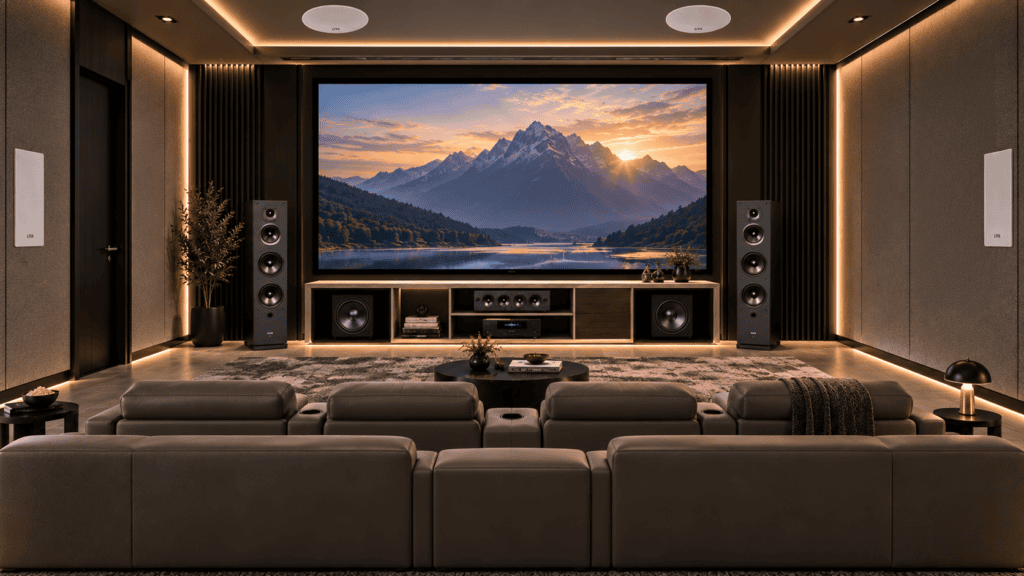
Floorstanding speakers, also called tower speakers, use a larger enclosure and typically provide greater scale and bass capability than compact bookshelf designs.
They can be particularly suitable for:
- Large living rooms
- Dedicated listening rooms
- Stereo music systems
- High-performance home theaters
For example, LiYA HiFi floorstanding speakers can form the main left and right channels of a larger home audio system.
The important point is that floorstanding speakers should have sufficient space around them and should be positioned correctly relative to the listening position.
Center Channel Speakers
The center speaker is especially important in a home theater.
It primarily handles dialogue and other center-channel information.
A center speaker is generally positioned near the display so that voices appear to originate from the screen.
Dolby's setup guidance recommends positioning the center speaker just below or above the TV so the sound appears to come directly from the screen.
A LiYA HiFi center-channel speaker such as the Maestro 7c can therefore become an important part of a dedicated home theater system.
In-Wall Speakers
In-wall speakers are installed into the wall rather than placed on furniture or stands.
They are useful when you want:
- Clean interior design
- Minimal visible equipment
- Surround sound
- Architectural audio
- A permanent installation
In-wall speakers can also help maintain a clean visual appearance in modern homes.
For a system where design matters as much as sound, architectural audio can provide a strong balance between performance and aesthetics.
In-Ceiling Speakers
In-ceiling speakers are installed flush with the ceiling.
They are commonly used for:
- Dolby Atmos systems
- Multi-room audio
- Background music
- Architectural audio
- Height channels
In an immersive home theater, overhead speakers can add a vertical dimension to the soundstage.
Dolby identifies ceiling-mounted speakers as one way to create the overhead component of a Dolby Atmos system.
LiYA HiFi's CS65BT in-ceiling speaker can be considered when a discreet ceiling installation is required.
Step 4: Choose the Right Subwoofer
A subwoofer is designed to reproduce low-frequency information.
While your main speakers reproduce most of the musical and cinematic content, the subwoofer handles deep bass that can add weight and impact.
A subwoofer can make a noticeable difference with:
- Movie soundtracks
- Action scenes
- Music
- Gaming
- Electronic music
- Large orchestral recordings
However, simply buying the biggest subwoofer is not necessarily the right approach.
The subwoofer should be suitable for your:
- Room size
- Main speakers
- Listening level
- Amplification
- Placement options
Dolby notes that bass is less directional than mid and high frequencies, which means subwoofer placement can be more flexible than the placement of the main speakers.
Nevertheless, experimenting with placement can help achieve more even bass throughout the listening area.
A LiYA HiFi subwoofer such as the P-S10 can be integrated into a larger home theater or music-focused system.
Step 5: Choose the Right Amplifier
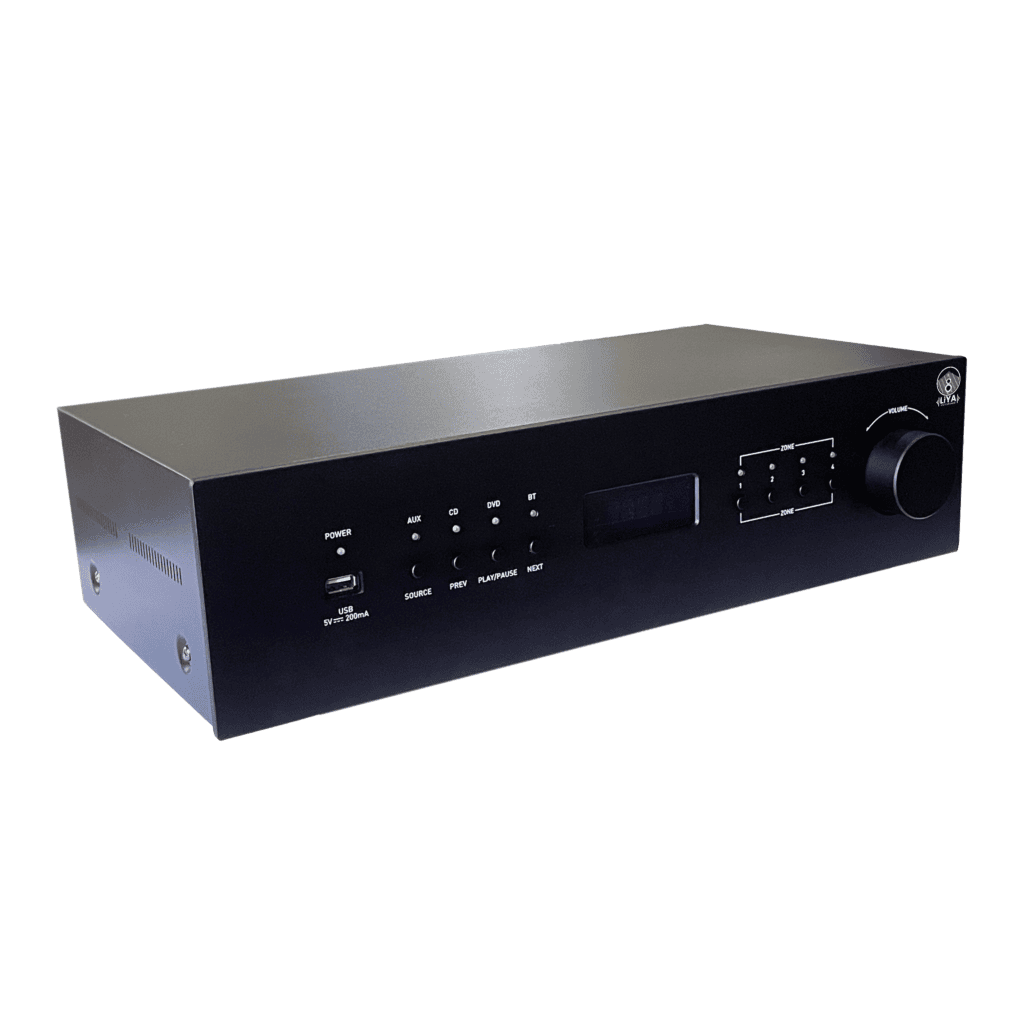
An amplifier provides the power required to drive your speakers.
This makes amplifier selection an important part of understanding how to build a home audio system.
When choosing an amplifier, consider:
- Speaker impedance
- Speaker sensitivity
- Power requirements
- Number of channels
- Listening room size
- Desired listening volume
- Future system expansion
You should also check the amplifier manufacturer's specifications and the speaker manufacturer's recommended operating range.
A powerful amplifier is not automatically better. The goal is to create a compatible combination where the amplifier can comfortably drive the speakers without operating beyond its intended limits.
LiYA HiFi amplifiers can be integrated into systems alongside LiYA speakers to create a coordinated audio solution.
How to Match Speakers With an Amplifier
Speaker and amplifier matching is an important part of building a reliable audio system.
Start by checking the speaker's:
- Nominal impedance
- Sensitivity
- Power handling
- Recommended amplification range
Then compare these specifications with the amplifier's capabilities.
For example, if your speakers require an amplifier capable of delivering a particular power level into their rated impedance, the amplifier should be selected accordingly.
Also consider the number of speakers you intend to operate.
A stereo system requires two main channels, while a larger home theater may require multiple amplified channels.
Therefore, determine your complete speaker layout before purchasing the amplifier.
Step 6: Decide How Many Speakers You Need
There is no universal number of speakers that works for every home.
Your required number depends on your system type.
Simple Stereo System
2 speakers
- Left
- Right
This is a straightforward configuration for music listening.
2.1 System
2 speakers + 1 subwoofer
This adds dedicated low-frequency reproduction.
3.1 Home Theater
3 speakers + 1 subwoofer
- Left
- Center
- Right
- Subwoofer
5.1 Home Theater
5 speakers + 1 subwoofer
- Front left
- Center
- Front right
- Surround left
- Surround right
- Subwoofer
7.1 Home Theater
7 speakers + 1 subwoofer
Two additional surround/rear channels expand the sound field.
Dolby Atmos
Atmos configurations can add overhead or height speakers.
For example, a 5.1.2 configuration uses five main surround speakers, one subwoofer and two overhead/height speakers. Dolby provides dedicated placement guidance for configurations such as 5.1.2 and 7.1.2.
Internal Link: How Many Speakers Do You Really Need for a Dolby Atmos Home Theater?
Suggested URL: /home-theater-speaker-guide/
2-Channel vs. Surround Sound Systems
The right system depends on your primary goal.
| System | Main Purpose | Typical Components |
|---|---|---|
| 2.0 | Music | 2 speakers + amplifier |
| 2.1 | Music + deeper bass | 2 speakers + subwoofer |
| 3.1 | TV & movies | L/C/R + subwoofer |
| 5.1 | Home theater | 5 speakers + subwoofer |
| 7.1 | Larger home theater | 7 speakers + subwoofer |
| 5.1.2 | Immersive home theater | 5 speakers + subwoofer + 2 height speakers |
A two-channel system focuses on stereo imaging and music reproduction.
A surround system, meanwhile, creates a larger sound field around the listener.
Consequently, the best configuration depends on what you actually want to experience.
5.1 vs. 7.1 vs. Dolby Atmos
Understanding the numbers makes it easier to plan a home theater.
In a 5.1 system:
- 5 = main speaker channels
- .1 = subwoofer/LFE channel
In a 7.1 system:
- 7 = main speaker channels
- .1 = subwoofer/LFE channel
A 5.1.2 Dolby Atmos configuration adds two overhead or height speakers.
Dolby explains that these additional height channels allow sounds to be positioned above the listener, creating a more immersive three-dimensional sound field.
For detailed installation guidance, use Dolby's official Dolby Atmos Speaker Setup Guide.
Speaker Placement for the Best Sound
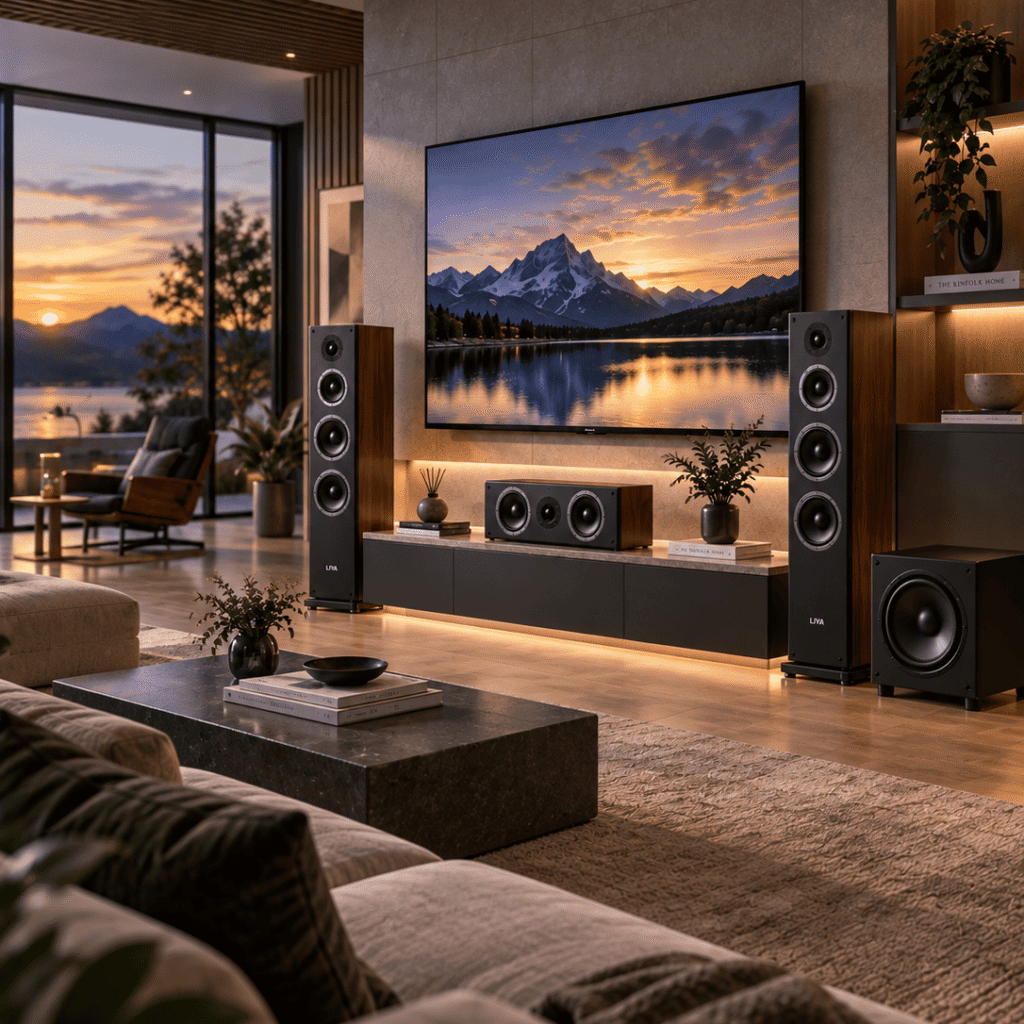
Even expensive speakers can perform poorly if they are placed incorrectly.
Speaker placement should therefore be considered while planning the system rather than after everything has been installed.
Front Left and Right Speakers
Your main left and right speakers should generally be positioned at the front of the listening area.
Keep them at a similar distance from the primary listening position when possible.
Toe-in can also be adjusted so the speakers point toward the listening position.
Dolby notes that toe-in can help create a focused listening "sweet spot."
Center Speaker Placement
Place the center speaker close to the display.
The goal is for dialogue to appear to come directly from the screen.
Avoid placing the center speaker too far above or below the display if doing so makes voices appear disconnected from the image.
Surround Speaker Placement
Surround speakers should be positioned around the listening area rather than directly beside the display.
Their purpose is to create a surrounding sound field.
The exact position depends on the selected format, room geometry, and seating arrangement.
In-Ceiling Speaker Placement
For overhead audio, placement should be planned around the primary listening position.
Do not simply install ceiling speakers wherever there is free ceiling space.
Dolby recommends following configuration-specific placement guidance and notes that professional installation is recommended for overhead speakers.
Subwoofer Placement
Unlike the main speakers, the subwoofer can usually be positioned more flexibly.
However, room modes can cause certain locations to sound much louder or weaker than others.
Therefore, test more than one location when possible.
How to Build a Home Audio System for a Small Room
Small rooms require careful planning.
A common mistake is choosing oversized equipment simply because larger speakers appear more powerful.
Instead, consider:
- Listening distance
- Speaker dimensions
- Room acoustics
- Bass response
- Available floor space
- Seating position
Bookshelf speakers can be a practical option when floor space is limited.
In-wall and in-ceiling speakers can also reduce the amount of equipment occupying the room.
For example, a compact system could use bookshelf speakers, a compact subwoofer and an appropriately matched amplifier.
The result can provide an engaging listening experience without making the room feel crowded.
How to Build a Home Audio System for a Large Room
Large rooms introduce different challenges.
A greater listening distance can increase the need for speakers capable of producing sufficient output and maintaining a convincing soundstage.
Floorstanding speakers can be useful in larger rooms because of their scale and ability to produce substantial output.
A larger system may also benefit from:
- Dedicated subwoofer
- Center speaker
- Surround speakers
- Multiple listening zones
- Architectural speakers
- More capable amplification
However, room acoustics remain important regardless of system size.
A large room filled with hard reflective surfaces can create unwanted reflections and reduce clarity.
Traditional vs. In-Wall and In-Ceiling Audio
There are two broad approaches to home audio design.
Traditional Speakers
These are visible speakers placed on:
- Floors
- Shelves
- Cabinets
- Speaker stands
They offer flexibility because you can reposition them more easily.
Architectural Speakers
In-wall and in-ceiling speakers are integrated into the architecture of the room.
They can be particularly useful when:
- Interior design is important
- Floor space is limited
- You want minimal visible equipment
- You are building or renovating a room
LiYA HiFi offers architectural audio options for installations where performance and visual integration need to work together.
For more information, see:
Internal Link: The Homeowner's Blueprint to Multi-Room Audio: In-Ceiling vs. Traditional Wireless Speakers
Suggested URL: /multi-room-audio-blueprint-ceiling-vs-wireless/
Room Acoustics Matter More Than You Think
Once you understand how to build a home audio system, the next consideration is how the room interacts with sound.
Walls, floors, ceilings, windows, curtains and furniture can all affect what you hear.
Hard surfaces can create reflections, while soft furnishings can help absorb some sound energy.
You do not necessarily need a dedicated recording studio to improve your room.
Simple changes can include:
- Adding rugs
- Using curtains
- Avoiding completely empty walls
- Positioning furniture strategically
- Keeping speakers away from unnecessary obstructions
Dolby also recommends considering room acoustics and reflections when planning a home theater.
For a deeper discussion about placement, link to:
Internal Link: Speaker Placement Guide: 15 Common Mistakes That Ruin Great Sound (And How to Fix Them)
Suggested URL: /speaker-placement-guide-common-mistakes/
Common Home Audio System Mistakes
Building a good system becomes easier when you know what to avoid.
1. Buying Speakers Without Measuring the Room
Room dimensions influence speaker selection and placement.
2. Choosing the Biggest Speakers
Bigger does not automatically mean better for every room.
3. Ignoring the Amplifier
Speakers and amplification should be considered together.
4. Placing Speakers Wherever They Fit
Placement directly affects imaging, tonal balance and immersion.
5. Putting the Subwoofer in a Random Location
Experiment with placement to find smoother bass.
6. Ignoring the Center Speaker
In movie-focused systems, dialogue clarity makes the center channel particularly important.
7. Installing Ceiling Speakers Without Planning
Overhead speakers should be positioned relative to the seating area and system configuration.
8. Buying Components One at a Time Without a System Plan
A system should be designed as a complete chain.
Example LiYA HiFi Home Audio Systems
Once you understand how to build a home audio system, you can create different configurations depending on the room and listening requirements.
Example 1: Compact Music System
A compact setup could include:
- LiYA HiFi Maestro 7s bookshelf speakers
- Compatible LiYA amplifier
- Streaming source
This type of system can work well when space is limited and music is the primary priority.
Example 2: Premium Stereo System
For a larger listening room:
- LiYA HiFi Maestro 7 floorstanding speakers
- Compatible LiYA amplifier
- Dedicated subwoofer where appropriate
The larger speakers can create a more substantial presentation while the amplifier provides the necessary drive.
Example 3: Home Theater System
A dedicated home theater could combine:
- LiYA HiFi Maestro 7 front speakers
- LiYA HiFi Maestro 7c center speaker
- LiYA HiFi surround speakers
- LiYA HiFi P-S10 subwoofer
- LiYA HiFi in-ceiling speakers
- Suitable amplifier/AV electronics
The exact configuration should be determined by the room dimensions, seating layout and desired surround format.
Example 4: Discreet Architectural Audio
For a minimalist living room:
- LiYA HiFi in-wall speakers
- LiYA HiFi CS65BT in-ceiling speakers
- Subwoofer
- Suitable amplification
This approach keeps much of the audio hardware integrated into the room while still creating a dedicated audio experience.
How to Build a Home Audio System Without Overspending
A good system does not require spending money on every available component.
Instead, allocate your budget according to your priorities.
If music is your priority, focus on the main stereo speakers and amplifier.
Or you love movies, consider the complete surround system, including the center channel and subwoofer.
If aesthetics are important, architectural speakers may be worth considering.
Most importantly, avoid spending heavily on one component while leaving the rest of the system poorly matched.
A balanced system usually provides a more sensible foundation for future upgrades.
Should You Upgrade Speakers or the Amplifier First?
There is no universal answer.
If your speakers are unsuitable for the room, changing the speakers may make the biggest practical difference.
If your speakers are already appropriate but the amplifier cannot comfortably drive them, upgrading the amplification may be more appropriate.
Similarly, if the system sounds thin in the low frequencies, adding or improving the subwoofer may address the specific limitation.
Therefore, identify the weakest part of your current system before upgrading.
How to Build a Home Audio System That Can Grow
A useful approach is to plan for future expansion.
You might begin with:
2.0 → 2.1 → 3.1 → 5.1 → immersive audio
For example, start with a pair of quality stereo speakers and an amplifier.
Later, add a subwoofer.
If you move toward home theater, add a center channel and surround speakers.
Finally, architectural or ceiling speakers can be introduced if you want an immersive setup.
This staged approach allows the system to evolve without replacing everything at once.
A Simple Home Audio System Checklist
Before purchasing anything, check the following:
Room
- Have you measured the room?
- Have you identified the main seating position?
- Have you considered room acoustics?
- Do you know where the equipment will be installed?
Speakers
- Have you selected the right speaker type?
- Are the speakers suitable for the room?
- Is there enough space around the speakers?
- Have you planned the placement?
Amplifier
- Does the amplifier match the speakers?
- Is the amplifier suitable for the required number of channels?
- Is there enough power for your intended listening level?
Subwoofer
- Does your system need a subwoofer?
- Is the subwoofer suitable for the room?
- Have you considered its placement?
Home Theater
- Have you selected the correct channel configuration?
- Is the center speaker positioned correctly?
- Are surround speakers positioned around the seating?
- Are overhead speakers planned around the listening position?
Frequently Asked Questions
How do I build a home audio system?
To build a home audio system, first determine your listening goals and room size. Then select suitable speakers, an amplifier, and a subwoofer if required. Finally, plan speaker placement, connect the components and calibrate the system.
What speakers do I need for a home audio system?
The speakers you need depend on your application. A stereo system may require two speakers, while a home theater can use front, center, surround, height and subwoofer channels.
Do I need a subwoofer for a home audio system?
Not always. However, a subwoofer can add deeper and more powerful low-frequency reproduction, particularly for movies, gaming and music with substantial bass content.
Are floorstanding speakers better than bookshelf speakers?
Neither is automatically better for every room. Floorstanding speakers can provide greater scale and output, while bookshelf speakers can be easier to integrate into smaller spaces.
Are in-wall speakers good for home audio?
Yes. In-wall speakers can provide high-quality audio while keeping the room visually clean. They are particularly useful for architectural installations and home theaters.
Are in-ceiling speakers good for home theater?
In-ceiling speakers can be used for overhead or height channels in immersive home theater systems. Their placement should be planned around the listening position and selected audio format.
How many speakers do I need for a home theater?
It depends on the desired configuration. Common systems include 5.1 and 7.1, while Dolby Atmos systems can add height channels such as 5.1.2 or 7.1.2.
What should I buy first when building a home audio system?
Start by defining the room, listening goals and system configuration. From there, choose speakers and amplification as a matched system rather than purchasing individual components without a plan.
Final Thoughts
Understanding how to build a home audio system is ultimately about creating a balanced relationship between the room, speakers, amplifier, subwoofer and listener.
Start with the room.
Then define how you will use the system. From there, choose the speaker type, determine the number of channels, select compatible amplification and plan the placement carefully.
A compact bookshelf system can deliver excellent results in a smaller room. Floorstanding speakers can provide a larger presentation when space allows. Meanwhile, in-wall and in-ceiling speakers can create a discreet architectural solution.
For home theater, the center speaker, surround channels, subwoofer and overhead speakers become increasingly important as the system becomes more immersive.
Most importantly, don't choose components in isolation. Build the system as a complete audio solution.
With thoughtful planning, correct speaker placement and properly matched components, your home audio system can deliver an experience that sounds impressive while fitting naturally into your space.