
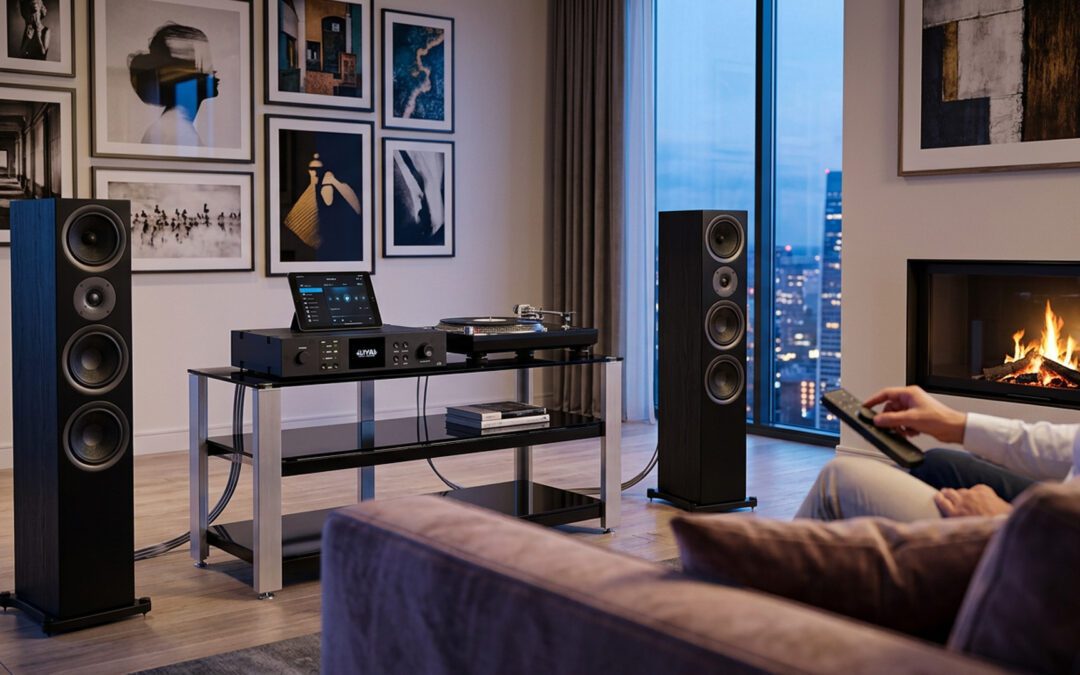
Are you seeking a clutter-free home that still delivers concert-hall audio performance? You are certainly not alone. The modern luxury home is a sanctuary of minimalist design, clean lines, and intentional spaces. However, for decades, the high-fidelity audio community lived by a singular, rigid dogma: power requires mass. Audiophiles and professional integrators alike equated sonic transparency, dynamic headroom, and deep, controlled bass with massive, heat-generating Class AB amplifiers. These components, often weighing as much as a small appliance, required dedicated industrial-grade racks, elaborate ventilation systems, and significant floor real estate.
Fortunately, in 2026, the landscape of luxury interior design and home cinema has shifted toward "stealth integration." Modern homeowners, architects, and designers now demand a minimalist aesthetic—an environment where sound is felt and heard, but never seen. This demand has sparked a massive revolution in audio engineering, elevating Class D amplification from a niche, misunderstood technology to the gold standard for high-end, hidden soundscapes. By leveraging the extreme efficiency of modern Class D amplification, homeowners and designers can now integrate powerful audio systems into minimalist interiors where traditional amplifiers would simply take up too much space or generate too much heat. The shift toward stealth integration means that sound is now felt and heard, but never seen. Consequently, this engineering revolution has made Class D amplification the gold standard for invisible, high-performance systems.
Debunking Myths: How Class D Amplification Works
To understand why this technology excels, one must analyze how Class D amplification functions. Many traditionalists once dismissed Class D amplification as "digital," incorrectly assuming it meant the sound was cold or harsh. In reality, Class D is simply a highly efficient method of analog signal processing. Unlike older Class AB designs that waste energy as heat by keeping output transistors in a constant state of partial conduction, Class D amplification utilizes high-speed switching technology.
Furthermore, it employs Pulse Width Modulation (PWM). The audio signal is converted into a series of rapid-fire pulses where the transistors are either fully "on" or fully "off." Because they are never lingering in a state of partial resistance, they generate minimal heat. In addition to thermal efficiency, the design architecture has matured significantly. Modern circuits now incorporate sophisticated feedback loops to reduce distortion levels that were once considered the primary drawback of early switching designs. As a result, today’s high-end Class D amplification units provide sonic clarity that rivals even the most expensive, massive Class A vacuum tube or transistor-based designs. Therefore, you are not sacrificing audio fidelity for the sake of convenience; you are gaining a modern, refined sound signature. Because of this thermal efficiency, Class D amplification is the preferred choice for custom, hidden installations that lack natural ventilation.
Why Architectural Audio Requires Class D Amplification
When installing in-wall or in-ceiling speakers, you face unique acoustic challenges. Since the wall cavity acts as a secondary enclosure, your amplifier must exert total control over the drivers. Class D amplification provides the high damping factor necessary to keep speaker diaphragms precise. As a result, you achieve the tight bass and crystalline highs required for a true high-end experience, even when speakers are hidden from view.
Moreover, architectural speakers often require higher current reserves to overcome the resistance of long, in-wall cable runs. Traditional linear power supplies can struggle with these demands, leading to compression during dynamic peaks in music or movies. However, the high-efficiency power stages of Class D amplification are designed to handle these loads with ease. Consequently, your audio remains dynamic and punchy, ensuring that a movie explosion or a complex orchestral piece is reproduced with the exact intensity the artist intended.
Additionally, consider the integration of multiple zones. Architectural audio often involves multi-room setups where you need to power different spaces simultaneously. With traditional amplification, this would require a massive, energy-sucking rack. With Class D amplification, you can pack high-wattage, multi-channel performance into a slim, 1U or 2U chassis. This high power density means you can deliver the current required to drive high-impedance architectural speakers without sacrificing your living room’s minimalist floor plan.
Maximizing Performance with Class D Amplification
If your goal is to curate a space where design and audio coexist, you must plan your installation strategically. Because Class D amplification allows for incredible power density, you can centralize your entire rack in a utility closet or a remote basement location. This removes all visible wires from your living space, allowing the architecture of your home to shine. Furthermore, a modern Class D amplification module is perfectly suited for digital signal processing (DSP). Therefore, you can easily fine-tune your architectural speakers to match the exact acoustics of your room, compensating for wall reflections or unusual room shapes that would otherwise degrade sound quality.
Additionally, consider the long-term benefits of reduced heat output. Electronics that run cooler almost always last longer. By choosing Class D amplification, you reduce the stress on internal components like capacitors and microchips. Thus, your investment remains reliable for years to come. In addition, the reduced electrical consumption aligns perfectly with the modern push toward sustainable, energy-efficient smart home ecosystems. It is a win-win scenario for both the interior designer and the dedicated listener.
When you decide to implement this technology, ensure you select professional-grade modules. While consumer-grade Class D has its place, LiYA HiFi architectural amplifiers utilize specialized output filters that ensure the frequency response remains flat regardless of the speaker load. This level of technical precision is what separates a standard audio setup from a true, reference-grade, invisible home cinema experience.
The Future of the Invisible Home Cinema
The transition to Class D amplification is not merely a technical choice; it is a fundamental shift in how we perceive the relationship between technology and living space. We are moving away from the era of "conspicuous consumption," where the size and weight of an amplifier were status symbols. We are entering an era of "intelligent performance," where the most sophisticated technology is the kind that works seamlessly and invisibly in the background.
Imagine walking into your living room. There are no bulky floor-standing speakers blocking the view. There are no massive racks humming with cooling fans. Instead, you tap a button on your tablet, and the room fills with rich, detailed, high-fidelity sound. The bass is deep and authoritative, the mids are lush and detailed, and the highs are crisp and clear. This is the promise of Class D amplification. It bridges the gap between the demanding world of high-end audio and the clean, organized world of modern interior design.
By embracing this technology, you are future-proofing your home. As audio formats continue to evolve—from object-based surround sound like Dolby Atmos to high-resolution, uncompressed music streaming—your architectural system will require an amplification platform that is agile, powerful, and efficient. Class D amplification provides exactly that platform. It is capable of handling the high-speed data requirements of modern audio processing while maintaining the cool-running reliability that custom installation requires.
Conclusion: A New Era of Invisible Sound
The transition to this technology is a major upgrade. By embracing the efficiency and clarity provided by Class D amplification, you no longer have to choose between a clean aesthetic and audiophile-grade performance. It is a win-win scenario for both the interior designer and the dedicated listener.
We at LiYA HiFi believe that the technology driving your music and movies should be as refined as the architecture of your home. By utilizing the incredible efficiency, power density, and sonic transparency of Class D amplification, you no longer have to compromise. You can have the minimalist, open-concept home of your dreams, paired with a soundscape that feels like it’s coming from the air itself rather than a box. The future of audio is hidden, efficient, and breathtakingly clear.
Ready to transform your home? Explore our professional-grade LiYA Architectural Amplifiers and discover how we are redefining the limits of high-end, hidden audio.