
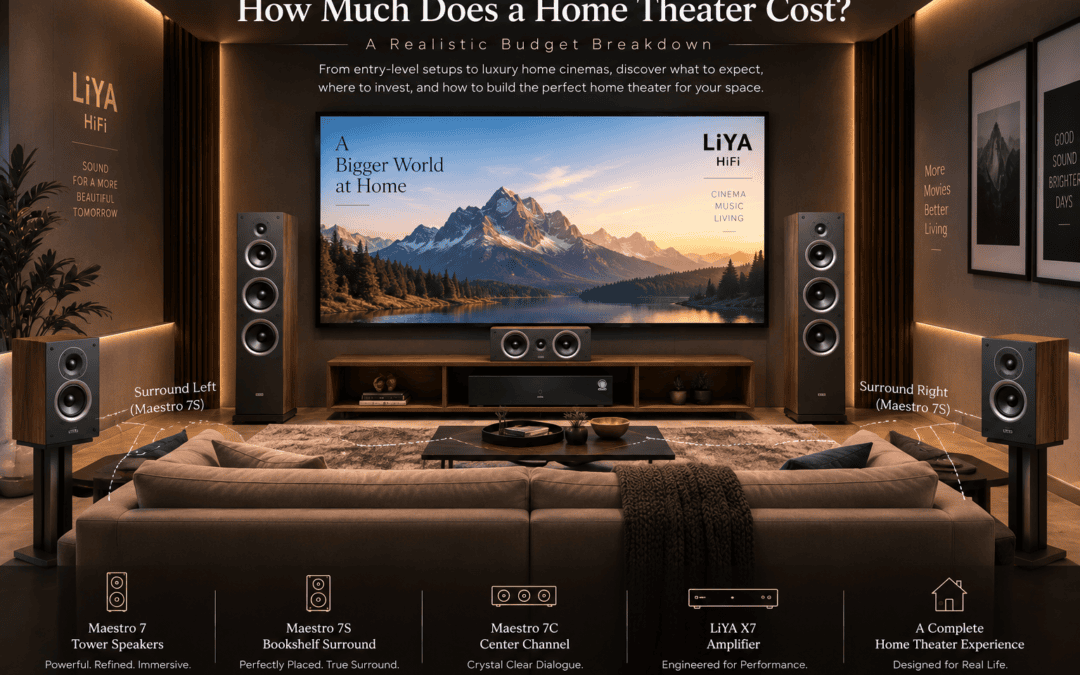
If you're wondering about home theater cost, there is no single number that applies to every setup. A basic home theater in a living room can start at a relatively modest budget, while a premium dedicated home cinema can require an investment of ₹10 lakh, ₹20 lakh, ₹30 lakh, or considerably more.
The cost of a home theater depends on much more than the speakers and screen. Room size, speaker configuration, amplification, projector or television, subwoofer, acoustics, seating, wiring, installation, calibration, and automation can all influence the final home theater setup cost.
The good news is that you don't necessarily need to spend a fortune to enjoy immersive sound and a cinematic experience.
The key is to understand where your home theater budget should go and which components deserve greater attention at different price levels.
In this guide, we'll break down realistic home theater costs in India, explore what you can expect at different budgets, and explain how to build a system that delivers the best possible experience for your room and requirements.
Home Theater Cost in India: A Quick Budget Guide
Before getting into individual components, here's a practical overview of potential home theater budget ranges.
| Home Theater Level | Approximate Budget | Best Suited For |
|---|---|---|
| Entry-Level | ₹1–3 lakh | Living rooms and first-time buyers |
| Mid-Range | ₹3–7 lakh | Serious movie and music enthusiasts |
| Premium | ₹7–15 lakh | Dedicated home cinema rooms |
| Luxury | ₹15–30 lakh+ | High-end private cinemas |
| Bespoke | ₹30 lakh+ | Fully customized home theaters |
These figures are broad planning ranges rather than fixed market prices. Actual home theater prices can vary significantly depending on the equipment selected, room dimensions, installation requirements, acoustic treatment, seating, interior work, and automation.
Another important consideration is whether you already own equipment.
If you already have a large television, for example, you can allocate more of your budget toward speakers, amplification, and room acoustics.
What Determines the Cost of a Home Theater?
The final home theater cost is usually made up of several different categories.
A complete home cinema may include:
- Television or projector
- Projection screen
- Front left and right speakers
- Center channel speaker
- Surround speakers
- Dolby Atmos in-ceiling speakers
- Subwoofer
- AV receiver
- AV processor
- Power amplifiers
- Streaming devices
- Speaker cables
- HDMI and network cabling
- Acoustic treatment
- Cinema seating
- Lighting
- Electrical work
- Installation
- Calibration
- Smart-home automation
This is why two home theaters with the same number of speakers can have completely different budgets.
A 5.1 system installed in a living room is very different from a professionally designed 7.1.4 cinema with acoustic treatment, a projector, dedicated amplification, and custom seating.
Entry-Level Home Theater Cost: ₹1–3 Lakh
An entry-level system can deliver a major improvement over television speakers or a basic soundbar without requiring a dedicated cinema room.
At this level, the focus should be on creating a balanced audio system rather than trying to include every possible feature.
A typical setup may include:
- 5.1-channel surround sound
- AV receiver
- Front left and right speakers
- Dedicated center speaker
- Surround speakers
- One subwoofer
- Existing television or reasonably sized display
- Basic installation and wiring
If you already own a good TV, it can make sense to direct more of the budget toward the audio system.
For example, a pair of LiYA Maestro 8 floor-standing speakers can serve as the front left and right channels in a suitable room, creating a strong foundation for movies and music.
The rest of the system can then be selected around the room size, amplifier capability, listening distance, and desired performance.
Who Should Consider a ₹1–3 Lakh Home Theater?
This budget can be suitable for:
- Apartments
- Smaller living rooms
- First-time home theater buyers
- Families upgrading from TV speakers
- People who want surround sound without constructing a dedicated cinema
At this level, you don't necessarily need motorized curtains, extensive acoustic treatment, multiple amplifiers, or a high-end projector.
The goal is to establish a strong foundation.
Mid-Range Home Theater Setup Cost: ₹3–7 Lakh
The ₹3–7 lakh range gives you considerably more flexibility.
At this level, you can move beyond a basic surround system and begin creating a more immersive home cinema experience.
Depending on the room and equipment selected, a mid-range system could include:
- 5.1.2 Dolby Atmos
- 5.1.4 Dolby Atmos
- Better front speakers
- Dedicated center channel
- In-wall surround speakers
- In-ceiling Atmos speakers
- Higher-performance subwoofer
- More capable AV receiver
- Large television or projector and screen
- Improved cabling
- Basic acoustic treatment
- Professional installation
A system built around LiYA Maestro 8 floor-standing speakers can provide a substantial front soundstage, while the LiYA LCR5 can be used as a dedicated center-channel speaker where appropriate.
For surround channels, LiYA IW8 in-wall speakers can provide an architectural solution that keeps the room visually clean.
For the overhead layer in a Dolby Atmos system, LiYA CS65BT in-ceiling speakers can be considered when their specifications and installation requirements suit the room.
This illustrates an important principle of home theater design:
Every speaker has a specific job.
The front stage, center channel, surround speakers, height speakers, and subwoofer should be selected as parts of one integrated system.
Premium Home Theater Cost: ₹7–15 Lakh
At ₹7–15 lakh, the project moves into serious enthusiast territory.
The focus should shift from simply purchasing individual components to designing the entire room and system together.
A premium home theater may include:
- 7.1.4 Dolby Atmos
- Premium floor-standing speakers
- Dedicated center channel
- In-wall surround speakers
- In-ceiling height speakers
- High-performance subwoofer
- Dedicated amplification
- Advanced AV processing
- High-quality projector and screen
- Acoustic treatment
- Dedicated cinema seating
- Professional installation
- System calibration
A LiYA-based configuration could combine Maestro 8 floor-standing speakers for the front stage, an LCR5 center channel, IW8 in-wall speakers for surround channels, and CS65BT in-ceiling speakers for the height layer.
A LiYA P-S10 subwoofer can provide the dedicated low-frequency foundation, subject to the requirements of the room and overall system.
Amplification should then be selected based on the speakers, channel count, room size, listening levels, and system requirements. LiYA amplification options such as the X4 or X7 may be considered where their capabilities are appropriate for the final configuration.
The exact combination should always be determined by the room rather than by a fixed shopping list.
Why Room Design Matters to Home Theater Cost
As the quality of your equipment increases, the room becomes increasingly important.
A room with excessive reflections, uncontrolled bass, or poor speaker placement can prevent an expensive system from performing at its best.
That means part of your home theater budget should be reserved for the room itself.
Consider:
- Room dimensions
- Seating position
- Speaker locations
- Listening distance
- Wall construction
- Ceiling height
- Flooring
- Windows and glass surfaces
- Acoustic treatment
- Equipment placement
For example, an IW8 in-wall speaker should not simply be installed wherever there is available wall space.
Its location should be planned around the seating position and the intended surround configuration.
Similarly, CS65BT in-ceiling speakers should be positioned according to the intended Dolby Atmos layout and listening area.
Planning these details before construction or renovation can help avoid expensive modifications later.
Luxury Home Theater Cost: ₹15–30 Lakh+
A luxury home theater is more than a collection of premium equipment.
It becomes a complete room-design project.
A luxury cinema may include:
- Dedicated cinema room
- Premium floor-standing speakers
- Dedicated center channel
- Architectural in-wall surround speakers
- Multiple in-ceiling Atmos speakers
- High-performance subwoofer system
- Dedicated power amplification
- Premium AV processing
- Large projection screen
- High-end projector
- Acoustic wall treatment
- Bass management
- Reclining cinema seating
- Custom lighting
- Motorized curtains
- Smart-home integration
- Professional calibration
- Custom interior design
A LiYA-based luxury system could incorporate Maestro 8 for the front soundstage, LCR5 as the center channel, IW8 architectural speakers for surround channels, CS65BT for Dolby Atmos height channels, and P-S10 for low-frequency reproduction.
The objective isn't simply to install more equipment.
It is to make every component work together within a controlled environment.
At this level, home theater cost increasingly reflects the quality of the room, installation, acoustic engineering, and system integration.
Bespoke Home Cinema Cost: ₹30 Lakh+
For homeowners building a completely customized private cinema, the budget can extend well beyond ₹30 lakh.
At this level, the project may include:
- Dedicated room construction
- Structural sound isolation
- Acoustic engineering
- HVAC noise control
- Custom acoustic treatment
- High-end projection
- Multiple subwoofers
- Multiple amplifiers
- Premium speaker systems
- Custom cinema seating
- Automated lighting
- Motorized curtains
- Home automation
- Custom interiors
- Professional calibration
At this stage, you're no longer simply buying a home theater system.
You're designing a private cinema environment.
Equipment such as LiYA's Maestro 8, LCR5, IW8, CS65BT, and P-S10 can form different parts of a carefully planned system, depending on the room and performance requirements.
How Much Should You Spend on Home Theater Speakers?
Speakers are among the most important parts of your home theater investment.
However, there is no universal rule that says you should spend a specific percentage of the total budget on speakers.
The right investment depends on:
- Room size
- Listening distance
- Speaker configuration
- Amplifier capability
- Desired volume
- Music and movie usage
- Acoustic conditions
- Future upgrade plans
A complete home theater may use several different speaker types.
Front Left and Right Speakers
The front left and right speakers create much of the front soundstage.
For larger rooms, a floor-standing design such as the LiYA Maestro 8 can be considered where its capabilities are appropriate for the room and system.
Center Channel Speaker
The center channel plays a crucial role in movie dialogue and central effects.
The LiYA LCR5 can be used as part of a dedicated center-channel arrangement where it matches the overall system design.
Surround Speakers
Surround speakers provide directional effects around the listening area.
The LiYA IW8 offers an in-wall approach for homeowners who want immersive surround sound without placing multiple visible speakers around the room.
Dolby Atmos In-Ceiling Speakers
Dolby Atmos adds a height dimension to compatible movie soundtracks.
The LiYA CS65BT can be incorporated into an in-ceiling Atmos system when its specifications and placement requirements are suitable.
Subwoofer
The subwoofer is responsible for reproducing deep low frequencies and adding physical impact to movie soundtracks.
The LiYA P-S10 can be incorporated as the dedicated low-frequency component of a suitably designed system.
The objective isn't simply to produce more bass.
It is to achieve controlled, deep, and well-integrated low-frequency performance.
Projector vs TV: Where Should Your Home Theater Budget Go?
The display can represent a significant portion of your home theater cost.
A projector-based system usually requires:
- Projector
- Projection screen
- Mounting
- Signal cabling
- Installation
- Calibration
A television simplifies many of these requirements.
When deciding between a projector and TV, consider:
- Room size
- Screen size
- Viewing distance
- Ambient light
- Projector throw distance
- Resolution
- Contrast
- HDR performance
- Installation requirements
A large projector screen can create a highly cinematic experience in a dedicated room.
However, a large TV may be more practical for a multipurpose living room, especially where ambient light cannot be controlled.
The most expensive display isn't necessarily the best choice.
The right display is the one that works best within your room.
Don't Forget the Subwoofer When Planning Home Theater Cost
One of the most frequently overlooked components in a home theater budget is the subwoofer.
A dedicated subwoofer reproduces the low-frequency information that gives movies their physical impact.
Explosions, engines, music scores, environmental effects, and other low-frequency content can all benefit from properly reproduced bass.
A LiYA P-S10 can be considered as part of a dedicated home theater system where its capabilities are appropriate for the room.
However, choosing a subwoofer isn't simply about buying the largest model available.
Room size, placement, listening position, crossover settings, and calibration all influence bass performance.
For larger rooms, multiple subwoofers may also be considered when the goal is more even bass distribution across the listening area.
For a deeper explanation of why a dedicated subwoofer matters, read our 5 Signs Your Home Audio System is Missing a Dedicated Subwoofer guide.
Acoustic Treatment and Its Impact on Home Theater Cost
Acoustic treatment is one of the expenses homeowners often overlook.
A room with hard floors, bare walls, glass, and large reflective surfaces can create unwanted reflections and excessive reverberation.
Depending on the room, acoustic treatment may include:
- Absorption panels
- Bass traps
- Diffusion
- Wall treatment
- Ceiling treatment
- Curtains
- Suitable flooring
A well-designed acoustic environment can help your speakers deliver greater clarity and consistency.
Acoustic Treatment Is Not Soundproofing
These two concepts are often confused.
Acoustic treatment controls sound within a room.
Soundproofing is designed to reduce sound transmission between spaces.
They solve different problems.
A dedicated home cinema may require acoustic treatment, sound isolation, or both depending on the building and intended use.
Home Theater Installation Cost: What Should You Budget For?
Installation is another important part of the overall home theater setup cost.
A basic living-room system may require relatively little installation.
A dedicated cinema can involve significantly more work.
Installation may include:
- Speaker wiring
- HDMI cabling
- Network cabling
- Electrical work
- In-wall cable routing
- In-ceiling speaker installation
- Projector mounting
- Screen installation
- AV rack installation
- Amplifier installation
- System configuration
- Speaker calibration
Architectural speakers require especially careful planning.
If you're installing LiYA IW8 in-wall speakers or CS65BT in-ceiling speakers, their positions should ideally be planned before the walls or ceilings are finished.
This helps ensure that the speakers align correctly with the seating and intended soundstage.
How Much Should You Spend on Home Theater Seating?
A dedicated cinema isn't complete without considering comfort.
If you plan to spend several hours watching movies, seating becomes an important part of the overall experience.
Cinema seating can range from simple theater chairs to premium powered recliners with features such as:
- Motorized reclining
- Adjustable headrests
- Footrests
- Cup holders
- USB charging
- Storage
- Premium upholstery
However, seating shouldn't consume the majority of your home theater budget.
A balanced system should allocate appropriate resources to audio, video, acoustics, installation, and comfort.
Where Should You Spend More on Your Home Theater?
If your budget is limited, prioritize the areas that can have the greatest effect on the final experience.
1. Room Design
Start with the room.
The dimensions and layout determine what type of system will work best.
2. Speakers
Your speakers form the foundation of the home theater's sound.
3. Subwoofer
Properly integrated low-frequency performance can dramatically improve the cinematic experience.
4. Amplification
The amplifier needs to be appropriate for the selected speakers and system configuration.
5. Acoustic Treatment
A controlled room allows the system to perform more consistently.
6. Display
Choose the display or projector according to the room rather than simply buying the most expensive option.
7. Installation and Calibration
Correct installation and calibration can help you get the most from your equipment.
Where Can You Save on Home Theater Cost?
A good home theater doesn't require purchasing everything at once.
You can potentially reduce the initial home theater cost by:
- Using an existing television
- Starting with a 5.1 system
- Adding Dolby Atmos later
- Choosing architectural speakers where appropriate
- Avoiding unnecessary automation
- Using existing furniture initially
- Planning future upgrades
- Installing the necessary wiring and infrastructure during renovation
The key is knowing which upgrades can be postponed and which decisions should be made from the beginning.
For example, you can upgrade amplification later.
However, installing in-ceiling speakers after the ceiling has been completed can be considerably more complicated than planning them during construction.
Should You Build Your Home Theater in Stages?
Absolutely.
A phased approach can make your home theater budget easier to manage.
Phase 1: Build the Core System
Start with:
- Front speakers
- Center channel
- Surround speakers
- Subwoofer
- AV receiver
A LiYA-based system could, depending on the room, use Maestro 8 for the front stage, LCR5 for the center channel, appropriate surround speakers, and P-S10 for low-frequency reproduction.
Phase 2: Add Dolby Atmos
Once the core system is established, add:
- In-ceiling height speakers
- Additional amplification if required
LiYA CS65BT in-ceiling speakers can be considered for the height layer when appropriate for the planned system.
Phase 3: Improve Acoustics
Invest in:
- Acoustic treatment
- Bass management
- Speaker positioning
- Calibration
Phase 4: Upgrade the Display
Consider:
- Larger screen
- Better projector
- Better projection screen
Phase 5: Upgrade Amplification
Dedicated amplification can be considered if the speakers, room, listening levels, and system configuration justify it.
A phased approach lets you create a strong foundation without having to commit your entire budget on day one.
Three Realistic Home Theater Budget Examples
Let's look at three hypothetical examples to understand how different home theater costs can translate into different system designs.
Example 1: ₹3 Lakh Living Room Home Theater
Goal: A significant improvement over TV speakers or a soundbar.
A possible system could include:
- 5.1-channel surround
- Quality front speakers
- Dedicated center channel
- Surround speakers
- One subwoofer
- AV receiver
- Existing large-screen TV
- Basic installation
- Basic acoustic improvements
If the room has sufficient space, LiYA Maestro 8 can be considered for the front left and right channels as part of a properly matched system.
The priority should be balance rather than simply maximizing the cost of one component.
Example 2: ₹8 Lakh Dedicated Home Cinema
Goal: A serious cinematic experience.
A possible configuration could include:
- 5.1.4 or 7.1.4 Dolby Atmos
- High-quality front speakers
- Dedicated center channel
- In-wall surround speakers
- In-ceiling Atmos speakers
- Dedicated subwoofer
- AV receiver or processor/amplifier combination
- Projector and screen
- Acoustic treatment
- Cinema seating
- Professional installation
A LiYA-based configuration could combine:
Maestro 8 — front left and right
LCR5 — center channel
IW8 — in-wall surround channels
CS65BT — in-ceiling Atmos channels
P-S10 — subwoofer
The final amplification should be selected according to the complete system and room.
Example 3: ₹20 Lakh Luxury Home Cinema
Goal: A premium private cinema experience.
A possible system could include:
- Premium floor-standing front speakers
- Dedicated center channel
- Architectural surround speakers
- Multiple in-ceiling Atmos speakers
- High-performance subwoofer system
- Dedicated amplification
- Premium AV processing
- Large projection screen
- High-end projector
- Dedicated acoustic treatment
- Reclining cinema seating
- Lighting control
- Home automation
- Professional calibration
A LiYA-based configuration could incorporate:
Maestro 8 — front soundstage
LCR5 — center channel
IW8 — architectural surround
CS65BT — Dolby Atmos height layer
P-S10 — low-frequency reproduction
The important point is that the final system should be designed around the room rather than simply selecting the maximum number of products.
10 Common Home Theater Budget Mistakes
1. Spending Everything on the Projector
A great projector cannot compensate for poor audio or uncontrolled room acoustics.
2. Buying Speakers Without Considering the Room
Speaker selection should take room size, listening distance, and placement into account.
3. Ignoring the Center Channel
Movie dialogue depends heavily on the center channel.
4. Forgetting Acoustic Treatment
A highly reflective room can reduce clarity and immersion.
5. Buying Too Many Speakers
More speakers do not automatically mean better sound.
The configuration should match the room and intended listening experience.
6. Underestimating Installation
Wiring, mounting, electrical work, and calibration can add significantly to the total home theater cost.
7. Installing Architectural Speakers Too Late
In-wall and in-ceiling speakers should ideally be planned before the walls and ceilings are finished.
8. Choosing Components Independently
Speakers, amplifiers, subwoofers, and processors need to work together as a system.
9. Spending Too Much on Appearance
A beautiful cinema is important, but aesthetics should not compromise speaker placement or acoustics.
10. Having No Upgrade Plan
A properly planned system can be expanded over time.
The Best Home Theater Isn't Always the Most Expensive
It's tempting to assume that a ₹20 lakh home theater must sound better than a ₹5 lakh system.
That's not necessarily true.
A poorly designed ₹20 lakh system can be less enjoyable than a carefully planned ₹5 lakh system.
The best home theater is the one where the:
- Room
- Speakers
- Amplification
- Subwoofer
- Display
- Acoustics
- Installation
- Calibration
work together.
This is why system design matters as much as individual component selection.
A LiYA Maestro 8, LCR5, IW8, CS65BT, P-S10, and suitable amplification can each perform different roles within a home theater, but their value ultimately comes from how effectively they are integrated into the room.
Where Does LiYA HiFi Fit Into a Home Theater?
A modern home theater often benefits from combining different types of speakers.
Floor-standing speakers can create a powerful front soundstage, while architectural speakers can provide surround and height channels without dominating the interior.
A potential LiYA system could include:
| Home Theater Role | LiYA Product |
|---|---|
| Front Left / Right | Maestro 8 |
| Center Channel | LCR5 |
| In-Wall Surround | IW8 |
| Dolby Atmos Height | CS65BT |
| Subwoofer | P-S10 |
| Amplification | X4 / X7, where appropriate |
These products should not be selected simply because they are from the same brand.
The right combination depends on:
- Room dimensions
- Seating arrangement
- Listening distance
- Number of channels
- Speaker specifications
- Amplifier requirements
- Acoustic conditions
- Personal listening preferences
The goal is to create a system where every component has a clear purpose.
How Much Should You Actually Spend on a Home Theater?
There is no single answer to the question of home theater cost.
If you want a straightforward living-room system, ₹1–3 lakh can be a reasonable starting point.
For a more serious setup, ₹3–7 lakh opens up considerably more possibilities.
At ₹7–15 lakh, you can start building a premium dedicated cinema with better speakers, amplification, acoustics, and display equipment.
At ₹15–30 lakh and beyond, you're entering luxury and bespoke home cinema territory, where room construction, acoustic engineering, automation, interiors, and professional system design become increasingly important.
The smartest approach is to start with the room and your requirements—not a shopping list.
Think about how many people will use the cinema, how large the room is, whether you prefer movies or music, whether you want Dolby Atmos, whether you need architectural speakers, and how much of the system you want to upgrade in the future.
Then build the system around those requirements.
Frequently Asked Questions About Home Theater Cost
How much does a good home theater cost in India?
A good home theater can start around ₹1–3 lakh for a relatively simple system and can increase to ₹7–15 lakh or considerably more for premium dedicated cinemas. The actual home theater cost depends on the room, equipment, speaker configuration, display, acoustics, installation, and other requirements.
Is ₹3 lakh enough for a home theater?
Yes. A ₹3 lakh budget can support a capable 5.1 home theater, particularly if you already own a suitable television. The key is to build a balanced system instead of overspending on one component.
How much should I spend on home theater speakers?
There is no universal percentage. Speaker spending should be based on room size, listening distance, speaker configuration, amplifier capability, desired performance, and future upgrade plans.
Is a projector better than a TV for a home theater?
Not always. A projector can provide a more cinematic large-screen experience, particularly in a dedicated dark room. A large TV can be more practical for a multipurpose living room or a room with significant ambient light.
How much does Dolby Atmos cost?
The cost of Dolby Atmos depends on the number of channels, speakers, amplification, room requirements, and installation. A basic Atmos configuration can be relatively affordable, while advanced systems with multiple height speakers and dedicated amplification can require a significantly larger investment.
Are in-wall speakers worth the money?
In-wall speakers can be an excellent choice when you want immersive sound while maintaining a clean interior. They are particularly useful for surround channels where visible floor-standing or bookshelf speakers may not suit the room.
LiYA IW8 in-wall speakers can be considered when their specifications, installation requirements, and intended placement are appropriate for the system.
Are in-ceiling speakers necessary for Dolby Atmos?
In-ceiling speakers are commonly used to reproduce the height channels in Dolby Atmos systems. Their necessity depends on the specific Atmos configuration and the type of speaker system being designed.
LiYA CS65BT in-ceiling speakers can be considered for suitable Dolby Atmos installations.
Do I need a dedicated room for a home theater?
No. A home theater can be created in a living room, family room, bedroom, or dedicated cinema. However, a dedicated room gives you greater control over acoustics, lighting, speaker placement, seating, and sound isolation.
Is acoustic treatment necessary for a home theater?
Acoustic treatment isn't mandatory for every setup, but it can significantly improve clarity and consistency, particularly in dedicated rooms and higher-performance systems.
Can I build a home theater in stages?
Yes. A phased approach can be an excellent way to manage your home theater budget. You can start with the core speaker system and add Dolby Atmos, acoustic treatment, better amplification, display upgrades, and other improvements over time.
Final Thoughts
The right home theater cost isn't determined by how much money you can spend.
It's determined by how intelligently you spend it.
A ₹2 lakh system can provide an excellent experience when it is properly matched to the room. A ₹20 lakh system can disappoint if the speakers are poorly positioned, the room is uncontrolled, or the components aren't properly integrated.
Start with the room.
Understand your viewing and listening requirements.
Choose speakers that suit the space. Match them with appropriate amplification. Give the center channel and subwoofer the attention they deserve. Plan architectural speakers before construction is complete. Consider acoustic treatment when necessary, and leave room for future upgrades.
Whether you're building a compact living-room setup or a dedicated luxury cinema, products such as LiYA Maestro 8, LCR5, IW8, CS65BT, and P-S10 can form different parts of a thoughtfully designed home theater system.
Because the best home theater isn't necessarily the one with the biggest price tag.
It's the one that makes you forget you're watching at home.