
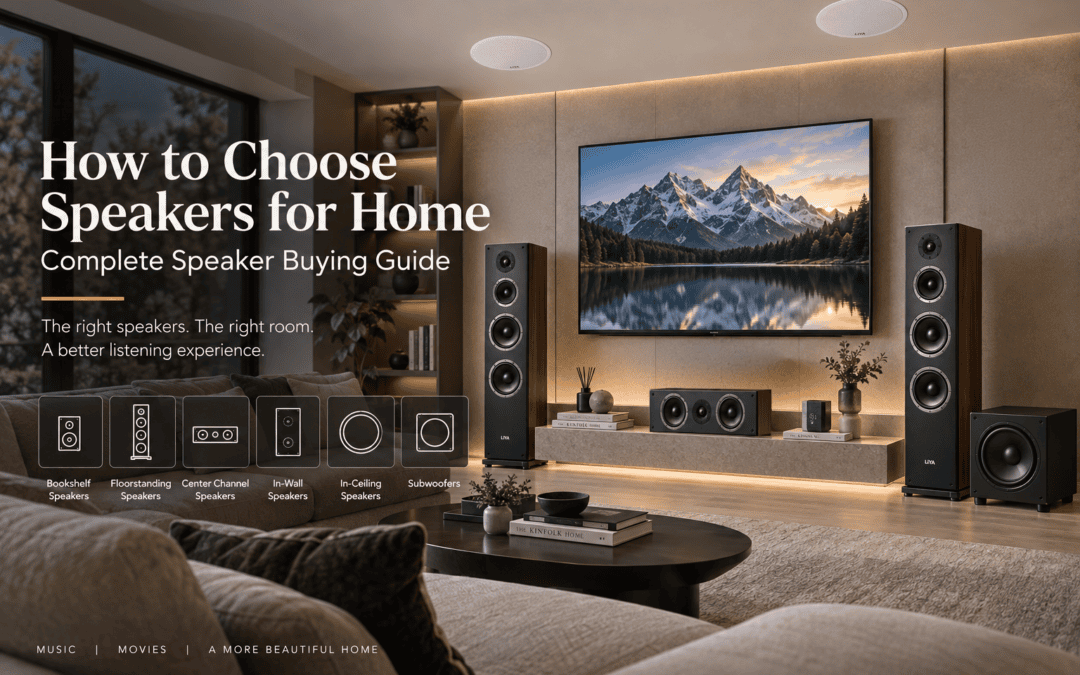
How to choose speakers for home is one of the most important questions to answer before building a home audio or home theater system. The right speakers can transform the way you experience music, movies, television, and gaming. However, choosing them involves much more than buying the biggest or most expensive model.
Your room size, listening distance, preferred type of content, amplifier, speaker placement, interior design, and budget all influence which speakers will work best for your space. Meanwhile, bookshelf speakers, floorstanding speakers, in-wall speakers, in-ceiling speakers, center channels, and subwoofers each serve different purposes.
In this guide, we explain how to choose speakers for home based on your room, listening requirements, system configuration, speaker placement, and desired audio experience.
Why Choosing the Right Speakers Matters
Speakers are the final stage of an audio system.
Your music source or movie soundtrack provides the audio signal, while the amplifier supplies power. The room then influences how that sound behaves. Ultimately, the speakers convert the electrical signal into the sound you hear.
For this reason, speaker selection is one of the most important decisions when creating a home audio system.
However, choosing speakers should not be based on size or price alone.
For example, a large floorstanding speaker may be an excellent choice for a spacious listening room. In contrast, a bookshelf speaker may be more practical for a compact apartment. Similarly, an in-wall speaker can suit a minimalist interior, while an in-ceiling speaker can work well for distributed audio or immersive home theater.
Therefore, the right choice depends on how all these elements work together.
Before deciding which speakers to buy, consider:
- Room size
- Listening distance
- Seating arrangement
- Type of content you listen to
- Desired listening volume
- Amplifier compatibility
- Speaker placement
- Room acoustics
- Interior design
- Budget
- Future system expansion
Understanding these factors makes it much easier to choose speakers for your home with confidence.
How to Choose Speakers for Home Based on Your Room
Your room should be one of the first things you consider when selecting speakers.
There is no universal speaker that performs perfectly in every environment. A model designed for a large dedicated theater may not be the most practical option for a small bedroom. Likewise, a compact bookshelf speaker may not provide the scale you want in a large entertainment room.
Start by measuring the space.
In particular, consider:
- Room length
- Room width
- Ceiling height
- Distance between the speakers
- Distance between the speakers and the main seating position
- Distance from the speakers to walls
- Number of listening positions
- Furniture placement
- Windows and other reflective surfaces
Room dimensions alone do not determine sound quality. In addition, furniture, flooring, curtains, wall materials, ceiling height, and room shape can affect the way sound travels.
As a result, how to choose speakers for home should always involve both the speaker and the room.
How to Choose Speakers for a Small Room
Small rooms require careful planning because there is less physical space for speaker placement and sound has less room to disperse.
For many compact spaces, bookshelf speakers are a practical choice. They provide a relatively small footprint while still allowing a dedicated stereo setup.
Depending on the design and manufacturer's recommendations, a bookshelf speaker can be placed on a proper stand or suitable furniture.
Furthermore, in-wall and in-ceiling speakers can work well in smaller spaces when maintaining a clean architectural appearance is important.
When selecting speakers for a small room, pay attention to:
- Listening distance
- Speaker spacing
- Bass response
- Wall proximity
- Amplifier compatibility
- Desired volume levels
A common mistake is assuming that a small room automatically requires the smallest possible speaker.
That approach is not always necessary. Instead, a well-designed larger speaker can also work in a smaller room when it is positioned correctly and integrated with the room.
For more information, read our Small Room Audio: How to Get Reference-Grade Sound in Compact Spaces guide.
How to Choose Speakers for a Large Room
Large rooms present a different set of requirements.
As the distance between the speaker and listener increases, the system may need greater output capability. Consequently, a larger acoustic presentation can help create a more engaging listening experience.
When deciding how to choose speakers for home in a large room, consider:
- Listening distance
- Speaker sensitivity
- Amplifier capability
- Desired volume
- Bass requirements
- Room acoustics
- Number of listening positions
Floorstanding speakers can be a strong option for larger rooms. Their larger cabinets and multiple drivers can provide a substantial soundstage and strong output.
Additionally, a dedicated subwoofer can be useful when deeper low-frequency reproduction is required.
Architectural speakers can also be incorporated into larger systems as surround, height, or distributed audio channels. As a result, you can create a comprehensive system without filling the room with additional speaker cabinets.
The Main Types of Speakers for Your Home
Understanding the different speaker types is the next step in learning how to choose speakers for home.
The major categories include:
- Bookshelf speakers
- Floorstanding speakers
- Center channel speakers
- In-wall speakers
- In-ceiling speakers
- Subwoofers
- Architectural speaker systems
Each type has a different role. Therefore, understanding these differences will make the buying process considerably easier.
Bookshelf Speakers
Bookshelf speakers are compact speakers designed to be positioned on a suitable stand, shelf, cabinet, or other stable surface.
Their smaller size makes them particularly useful when space is limited.
For example, bookshelf speakers can be suitable for:
- Bedrooms
- Offices
- Apartments
- Compact living rooms
- Secondary listening rooms
- Small stereo systems
- Systems paired with a subwoofer
One of their biggest strengths is flexibility.
When positioned correctly, a pair can produce excellent stereo imaging and detail without taking up the floor space of a large tower speaker.
However, smaller cabinets generally provide less low-frequency output than larger floorstanding designs.
That does not make bookshelf speakers inferior. Instead, they are designed for a different application.
Therefore, if you want a compact system with strong stereo performance, bookshelf speakers can be an excellent starting point.
Floorstanding Speakers
Floorstanding speakers, also called tower speakers, stand directly on the floor and generally use larger cabinets and multiple drivers.
They are commonly used for:
- Stereo music systems
- Large living rooms
- Dedicated listening rooms
- High-output systems
- Front left and right channels in home theaters
The larger cabinet volume can allow a floorstanding speaker to deliver a larger presentation and stronger low-frequency performance than many compact designs.
However, floorstanding speakers require more physical space.
Before installing them, consider:
- Distance from side walls
- Distance from rear walls
- Distance between the speakers
- Distance from the listening position
- Toe-in requirements
- Furniture arrangement
LiYA HiFi's Maestro range is designed around this traditional floorstanding approach, combining a substantial speaker presence with a premium interior aesthetic.
If you are specifically considering tower speakers, read our guide The Tower Advantage: Why Floor-Standing Speakers Belong in Your Home.
Center Channel Speakers
A center channel is particularly important in a home theater.
It is responsible for much of the dialogue and centrally positioned information in movie and television soundtracks.
Because dialogue is so important to the viewing experience, the center speaker should integrate well with the left and right front channels.
Otherwise, voices can sound noticeably different from other sounds moving across the front of the room.
For this reason, the center channel should be considered as part of the complete front soundstage rather than as an independent purchase.
LiYA HiFi's Maestro center-channel solutions can be incorporated into a dedicated home theater system alongside compatible front and surround speakers.
In-Wall Speakers
In-wall speakers are installed directly into the wall, allowing the audio system to become part of the architecture.
They can be useful for:
- Home theaters
- Surround channels
- Living rooms
- Architectural audio
- Minimalist interiors
- Multi-room systems
One of the biggest advantages of in-wall speakers is visual integration.
Instead of placing a large speaker cabinet on the floor, the speaker can sit flush with the wall. As a result, the grille can blend into the surrounding interior.
However, installation planning is critical.
The speaker's position should be determined before installation. During planning, take into account the seating position, room layout, listening height, and intended audio role.
LiYA HiFi's architectural speaker range provides solutions for homeowners who want high-quality audio while maintaining a clean interior.
For a combination of traditional and architectural speakers, read Pure LiYA Integration: How to Pair Floorstanding Towers with In-Wall Architectural Audio.
In-Ceiling Speakers
In-ceiling speakers are installed flush into the ceiling and are designed for applications where overhead or distributed sound is desirable.
They can be used for:
- Whole-home audio
- Multi-room music
- Kitchens
- Dining rooms
- Living spaces
- Home theaters
- Dolby Atmos height channels
Their biggest advantage is minimal visual impact.
Rather than occupying floor or wall space, the speaker becomes part of the ceiling.
However, placement matters.
In a home theater, ceiling speakers should be positioned according to the intended immersive audio configuration and seating arrangement.
For distributed audio, the placement strategy can be different because the objective may be even sound coverage throughout the room.
LiYA HiFi's CS65BT is an example of an in-ceiling solution designed for integrated architectural audio applications.
For a deeper comparison of architectural and wireless approaches, read The Homeowner's Blueprint to Multi-Room Audio: In-Ceiling vs. Traditional Wireless Speakers.
For Dolby Atmos installations, Dolby's official setup guidance also emphasizes speaker placement, listening position, speaker height, and room considerations.
Subwoofers
A subwoofer is designed to reproduce low-frequency sound.
Even when the main speakers already produce bass, adding a dedicated subwoofer can extend low-frequency performance. It can also allow the main speakers to focus more efficiently on their primary frequency range.
Subwoofers can be particularly useful for:
- Home theaters
- Action movies
- Electronic music
- Orchestral recordings
- Bass-heavy music
- Large rooms
- Immersive audio systems
However, simply adding a subwoofer is not enough.
Integration matters just as much as the subwoofer itself.
The subwoofer's placement, crossover, phase, and level should be adjusted so that bass becomes a natural part of the overall system.
In other words, the goal is not simply to hear more bass. Instead, the objective is to achieve better-integrated bass.
Bookshelf vs. Floorstanding Speakers
One of the most common questions when learning how to choose speakers for home is whether bookshelf or floorstanding speakers are better.
The answer depends on the application.
| Feature | Bookshelf Speakers | Floorstanding Speakers |
|---|---|---|
| Physical size | Compact | Larger |
| Floor space | Usually needs a stand or surface | Direct floor placement |
| Bass capability | Often more limited | Usually greater |
| Stereo imaging | Can be excellent | Can be excellent |
| Small rooms | Often convenient | Can work with careful placement |
| Large rooms | May need subwoofer support | Often well suited |
| Visual presence | Relatively discreet | More prominent |
| Subwoofer pairing | Common | Optional depending on system |
If space is limited, bookshelf speakers can provide excellent performance without dominating the room.
On the other hand, if you have a larger room and want a substantial stereo presentation, floorstanding speakers may be more appropriate.
Ultimately, choose according to the complete system rather than assuming one type is universally better.
In-Wall vs. In-Ceiling Speakers
In-wall and in-ceiling speakers are both architectural solutions. Nevertheless, their placement and applications are different.
In-wall speakers
In-wall speakers are positioned within the wall plane.
They can be used for:
- Front channels
- Center channels
- Surround channels
- Stereo listening
- Architectural installations
In-ceiling speakers
In-ceiling speakers are positioned overhead.
They can be used for:
- Height channels
- Whole-home audio
- Distributed music
- Kitchens
- Dining rooms
- Hallways
- Multi-room systems
Therefore, the choice between in-wall and in-ceiling speakers should be based on the role the speaker needs to perform.
How to Choose Speakers for a Living Room
Living rooms are often multifunctional spaces.
The same room may be used for:
- Music
- Movies
- Television
- Gaming
- Entertaining guests
- Background audio
Consequently, flexibility is particularly important.
Depending on the room, you might choose:
- Bookshelf speakers with a subwoofer
- Floorstanding speakers
- In-wall speakers
- In-ceiling speakers
- A stereo system
- A surround sound system
- A combination of traditional and architectural speakers
If music is your primary priority, a well-positioned stereo pair may be enough.
However, if movies and gaming are equally important, a surround or immersive home theater configuration may make more sense.
Interior design should also influence the decision.
For example, a pair of premium floorstanding speakers can become part of the room's visual identity. Meanwhile, architectural speakers can provide a more discreet appearance.
How to Choose Speakers for Home Theater
A home theater should be treated as a complete audio system rather than a collection of individual speakers.
Depending on the format, a home theater can include:
- Front left speaker
- Center channel
- Front right speaker
- Surround speakers
- Height speakers
- Subwoofer
Every speaker has a specific role.
The front stage handles much of the main action and dialogue. Surround speakers create spatial effects around the listener, while height speakers provide overhead information in immersive formats. Meanwhile, the subwoofer handles the lowest frequencies.
The exact number of speakers depends on the room and the intended audio format.
If you are planning a Dolby Atmos system, read How Many Speakers Do You Really Need for a Dolby Atmos Home Theater?
For a broader introduction to cinema audio, see What is a Surround Sound System? An Ultimate Guide to Home Cinema.
Understanding Speaker Specifications
Speaker specifications can look complicated. Fortunately, several numbers are particularly useful when comparing models.
Frequency Response
Frequency response describes the range of frequencies a speaker is designed to reproduce.
A wider published frequency range does not automatically mean better sound.
Instead, what matters is how consistently and accurately the speaker performs across its operating range.
Sensitivity
Sensitivity describes how efficiently a speaker converts amplifier power into acoustic output.
Higher sensitivity can be useful when you want higher output without requiring as much amplifier power.
Nevertheless, sensitivity should be considered alongside impedance, room size, listening distance, and amplifier capability.
Impedance
Impedance describes the electrical load presented by the speaker to the amplifier.
Common nominal ratings include:
- 4 ohms
- 6 ohms
- 8 ohms
The nominal figure does not tell the complete story because speaker impedance can vary across different frequencies.
Consequently, amplifier compatibility should always be considered when selecting speakers.
Power Handling
Power handling indicates how much electrical power a speaker is designed to handle under specified conditions.
It should not be interpreted as:
More watts automatically means better sound.
Instead, speaker sensitivity, impedance, amplifier output, room size, listening distance, and desired volume all need to be considered together.
How Important Is Speaker Placement?
Speaker placement is one of the most important parts of getting good sound.
Even an excellent speaker can perform poorly if it is positioned incorrectly.
Placement affects:
- Stereo imaging
- Soundstage
- Bass response
- Tonal balance
- Dialogue clarity
- Surround effects
- Listening consistency
For stereo systems, speaker spacing, listening distance, and toe-in can influence imaging.
Home theater, speaker height, distance, angle, and relationship to the seating position become even more important.
For in-wall and in-ceiling speakers, installation position should ideally be planned before construction or renovation work begins.
For more guidance, read our Speaker Placement Guide: 15 Common Mistakes That Ruin Great Sound (And How to Fix Them).
Traditional Speakers vs. Architectural Speakers
When deciding how to choose speakers for home, aesthetics can be just as important as acoustics.
Traditional speakers and architectural speakers offer two different approaches.
Traditional speakers
Bookshelf and floorstanding speakers can become visible design elements.
A premium tower speaker can complement furniture, materials, and the overall interior.
Architectural speakers
In-wall and in-ceiling speakers take a more discreet approach.
They are designed to integrate into the architecture so the room can remain visually clean.
Neither approach is automatically right for every home.
In fact, many modern systems combine both.
For example:
Floorstanding speakers for the front stereo stage + in-wall speakers for surround channels + in-ceiling speakers for distributed or immersive audio.
This approach allows the system to combine visible performance-focused speakers with discreet architectural audio.
How to Choose Speakers for Home Based on Your Listening Habits
Your content preferences should influence your speaker selection.
If You Primarily Listen to Music
Focus on:
- Stereo imaging
- Tonal balance
- Detail
- Soundstage
- Bass performance
- Listening distance
A pair of bookshelf or floorstanding speakers may be the foundation of the system.
If You Primarily Watch Movies
Consider:
- Center-channel performance
- Surround coverage
- Subwoofer integration
- Speaker matching
- Listening position
In this case, a dedicated home theater configuration may be more appropriate.
If You Want Whole-Home Music
Architectural speakers can provide a clean way to distribute audio throughout different spaces.
For instance, in-ceiling speakers can be particularly useful in kitchens, dining areas, hallways, and other rooms where floor or wall-mounted speakers may not be desirable.
If You Want Both Music and Movies
A hybrid system can provide the flexibility needed for both.
For example:
- Floorstanding front speakers
- Dedicated center channel
- In-wall surrounds
- In-ceiling height speakers
- Subwoofer
- Compatible amplifier
The exact configuration should be based on your room and listening requirements.
Don't Forget the Amplifier
Speaker selection should not happen independently from amplifier selection.
The amplifier and speakers need to work together electrically and acoustically.
When choosing an amplifier, consider:
- Speaker impedance
- Speaker sensitivity
- Recommended power range
- Number of channels
- Desired listening level
- Room size
- Listening distance
A speaker's performance can change significantly depending on the amplifier driving it.
This becomes particularly important in larger rooms and high-output home theater systems.
Therefore, a complete system should be designed as a combination of components rather than as a list of unrelated purchases.
Do Bigger Speakers Always Sound Better?
No.
Speaker size is only one part of the equation.
A compact bookshelf speaker can deliver excellent imaging and detail. In contrast, a larger floorstanding speaker can provide greater scale and potentially stronger low-frequency output.
Similarly, an in-wall speaker can provide a clean architectural installation, while an in-ceiling speaker can provide overhead or distributed audio.
Each type is designed for a different purpose.
The better question is not:
Which speaker is the biggest?
Instead, ask:
Which speaker is appropriate for my room and my system?
That question leads to much better purchasing decisions.
How to Build a Balanced Home Audio System
Instead of buying speakers one at a time, start by defining the complete system.
Step 1: Decide What You Will Listen To
Will the system primarily be used for:
- Music
- Movies
- Gaming
- Television
- Background music
- A combination
Step 2: Measure the Room
Record:
- Length
- Width
- Ceiling height
- Seating distance
- Available speaker locations
Step 3: Decide Where Speakers Can Go
Determine whether the room can accommodate:
- Floorstanding speakers
- Bookshelf speakers
- In-wall speakers
- In-ceiling speakers
- Wall-mounted speakers
Step 4: Consider the Seating Position
The main listening position should be established before final speaker placement.
This is particularly important for home theater and immersive audio.
Step 5: Match the Amplifier
Check speaker impedance, sensitivity, recommended amplification, and the desired listening level.
Step 6: Consider the Interior
Decide whether you want the audio system to:
- Become a visual centerpiece
- Blend into the interior
- Remain mostly hidden
Step 7: Plan Before Installation
If you are using in-wall or in-ceiling speakers, plan their positions before installation.
Architectural audio is easiest to integrate when considered during the design or renovation stage.
Common Speaker-Buying Mistakes
1. Choosing Based Only on Price
A higher price does not automatically mean a better match for your room.
2. Buying Without Measuring the Room
Room dimensions and listening distance should influence speaker selection.
3. Ignoring Placement
Even excellent speakers can sound disappointing when placed incorrectly.
4. Ignoring Amplifier Compatibility
Speaker impedance, sensitivity, and amplifier capability should be considered together.
5. Buying Too Many Speakers
More speakers do not automatically mean better sound.
Every speaker should have a defined role.
6. Ignoring the Center Channel
Dialogue reproduction is extremely important in a home theater.
7. Treating Architectural Speakers as an Afterthought
In-wall and in-ceiling systems should ideally be planned before installation.
8. Ignoring the Subwoofer
If deep bass is important, the subwoofer should be considered part of the overall system.
9. Prioritizing Appearance Over Acoustics
A beautiful room still needs sensible speaker placement.
10. Buying Components Without a System Plan
A balanced system is generally more useful than a collection of individually impressive components that were never designed to work together.
How LiYA HiFi Can Fit Different Home Audio Systems
LiYA HiFi offers speaker solutions across different categories, making it possible to build systems according to room size, listening preferences, architectural requirements, and home theater needs.
For traditional stereo listening, a system can be built around floorstanding or bookshelf speakers.
A dedicated home theater, the system can incorporate front speakers, a center channel, surround speakers, height speakers, and a subwoofer.
For minimalist interiors, architectural in-wall and in-ceiling speakers can integrate the audio system into the room itself.
Depending on the application, a LiYA HiFi system may include:
- Maestro floorstanding speakers for a traditional front soundstage
- Maestro bookshelf speakers for compact stereo applications
- Maestro center-channel speakers for home cinema
- IW-series in-wall speakers for architectural and surround applications
- LCR architectural speakers for front-channel applications
- CS-series in-ceiling speakers for distributed or immersive audio
- Subwoofer solutions for low-frequency reproduction
- LiYA HiFi amplification to drive the system
The exact combination should always be selected according to the room, seating arrangement, desired audio format, amplification, and listening preferences.
The fundamental principle is simple:
Every speaker should have a purpose.
A Simple Guide to Choosing the Right Speaker
If you are still unsure how to choose speakers for home, use this quick guide.
Choose Bookshelf Speakers If:
- You have limited space
- You want a compact stereo system
- You can use stands or suitable furniture
- You may add a subwoofer later
Choose Floorstanding Speakers If:
- You have sufficient floor space
- You want a larger stereo presentation
- You listen at higher levels
- You want speakers to become part of the interior
In-Wall Speakers If:
- You want a clean architectural appearance
- You are planning a home theater
- You want discreet surround speakers
- You are building or renovating the room
In-Ceiling Speakers If:
- You want distributed audio
- You want overhead audio
- You are planning a Dolby Atmos system
- You want minimal visual impact
Choose a Subwoofer If:
- You want deeper bass
- You watch action movies
- You listen to bass-heavy music
- Your main speakers need additional low-frequency support
Frequently Asked Questions About Choosing Home Speakers
What is the best type of speaker for a home?
There is no single speaker type that is best for every home. Bookshelf, floorstanding, in-wall, and in-ceiling speakers are designed for different rooms and applications. Therefore, the right choice depends on room size, listening distance, placement, system configuration, and personal preferences.
How do I choose speakers for my home?
Start by considering the room size, listening distance, intended use, speaker placement, amplifier compatibility, aesthetics, and budget. Then choose the speaker type that best fits those requirements.
Are floorstanding speakers better than bookshelf speakers?
Not necessarily. Floorstanding speakers can provide a larger presentation and greater low-frequency capability, while bookshelf speakers offer a compact footprint. In smaller rooms, bookshelf speakers can work particularly well, especially when paired with a suitable subwoofer.
Are in-wall speakers good for home theater?
Yes. In-wall speakers can be an excellent option for home theater systems, particularly when a clean architectural appearance is important. Nevertheless, correct placement and installation remain essential.
Are in-ceiling speakers good for music?
Yes. In-ceiling speakers can work well for distributed and background music when properly selected and installed. They can also be used as overhead channels in immersive home theater systems.
Do floorstanding speakers need a subwoofer?
Not always. Some floorstanding speakers can produce substantial bass on their own. However, a properly integrated subwoofer can extend low-frequency performance and may be beneficial for home theater or bass-heavy music.
How many speakers do I need for a home theater?
The number depends on the room, audio format, seating arrangement, and desired level of immersion. For example, a basic surround system requires fewer channels than a full immersive Dolby Atmos configuration.
Should all my home theater speakers be the same brand?
They do not have to be. However, matching the front soundstage and maintaining consistent characteristics across the system can help create a more cohesive listening experience.
How important is speaker placement?
Speaker placement is extremely important. Positioning affects imaging, tonal balance, bass response, dialogue clarity, and surround immersion.
What should I consider before buying speakers?
Consider your room size, seating position, listening distance, intended use, amplifier, placement options, aesthetics, desired sound, and budget before selecting the speaker type.
Final Thoughts: Choosing Speakers for Your Home
Learning how to choose speakers for home is ultimately about understanding the relationship between the audio system and the room where it will be installed.
The right system is not necessarily the one with the largest speakers, the highest power rating, or the most expensive components.
Instead, it is the system in which every component works together.
Your room, speakers, amplifier, placement, acoustics, and listening position all contribute to the final experience.
Bookshelf speakers can be an excellent solution for compact spaces. Floorstanding speakers can provide a powerful and visually prominent stereo experience. In-wall speakers can deliver architectural integration, while in-ceiling speakers can provide discreet distributed or immersive audio.
Meanwhile, subwoofers can add depth and impact to the lowest frequencies.
The key is to select each component according to its purpose.
Before you buy, ask yourself three questions:
What do I want to listen to?
What does my room allow me to install?
How do I want the audio system to look and sound within my home?
Once those questions are answered, choosing the right speakers for your home becomes much easier.
At LiYA HiFi, the goal is to bring together audio performance, engineering, and architectural design so that modern homes can enjoy a premium listening experience without compromising the character of the interior.
Choose the room first. system second. Choose the speakers third.
That is where a great home audio experience begins.